Discover Redmond’s Future

I sat shifting through some website material I found after receiving a postcard about the upcoming Downtown Bus + Rail Planning for January 26th, 6-8pm at Redmond City Hall. I was instantly curious and dug into the link on the post card.

https://redmond.gov/lightrailextension

But what I found was what I’d been curious about for some time. What in the world is going on with the transformation of downtown Redmond. First things first, let me show you a map I created first to get an idea of where and what we’re talking about.

First, Redmond in comparison to where Seattle is. Seattle is the large red zone to the left on the map that is labeled Seattle. Continue reading →

Living Subserviently to the Automobile

Let’s talk about how to describe effectively how the automobile, and our heavy dependency and emphasis in taxpayers dollars for the automobile to design and build roads and other infrastructure, homes, towns, and almost everything around the automobile has shaped our world. Here are a few terms I’ve started using. I don’t know if there are official terms for these things, but none the less I have observed and know of these systemic characteristics to exist in the United States today.
Dependent Communities – These are communities that can never be dependent on their immediate retail, infrastructure, and related facilities. The jobs aren’t located within reasonable distance, nor food, or other necessary items needed for living life on a day to day basis.
Red Line Divisions – Like the red-lined districts where “blacks” or “others” would never be loaned capital to improve their neighborhoods, the construction of many roadways were often done so in a distinctive and careful way as to split communities that were diverse into communities of sameness and inequity.
Motorist Elitism – This is less evident in Seattle & Cascadia than in much of America, but it is evident among the poor and the rich alike. The idea that one of means (i.e. the person with money) would only drive and looks down upon those that don’t drive as a lesser person who has made bad decisions or some other nonsense. This elitism is misguided, myopic, and filled with contradictions on many levels, not including the idea that it’s horrifyingly wrong.
Subservient Marketing Choice – This is the practice of marketing a “make your life simpler” style product or lifestyle that really locks one into an ongoing monetary mortgage against this lifestyle. Auto-dependency itself is one of those things, and we’re all bound by this to some degree even while alone in a mountain cabin – as we’re all part of this ecosystem Earth. However this is specifically oriented toward the suburban lifestyle dependency and subservience that is often coupled with motorists’ elitism and dependent communities. In the end, it causes those sold this lifestyle to be subservient and supportive of the entities (businesses, government, or other entity) that keep them in this lifestyle.
In summary of these terms, I leave this post with a question and a quote. The question is, if you’ve got any additional quotes, or know of  better way to more accurately state these specific characteristics of modern American life, please share them in the comments or ping me on Twitter @transitsleuth. The quote is on this general topic in which we find most of the populace today.
“Dependence begets subservience and venality, suffocates the germ of virtue, and prepares fit tools for the designs of ambition.” – Thomas Jefferson

Urban Seattle Blogs – Rollcall

I sat down recently and put together the list of how to stay informed on what’s up in Seattle and the immediate area. Here’s the run down.

Transportation Specific Blogs

Neighborhood and Related Blogs

Other Extremely Useful Sites

Others that aren’t Seattle specific but really good reads and often report on Seattle urban and transportation news.

Ok, so there’s gotta be more. Please ping me @TransitSleuth and help me build this list even bigger!

Ranting about Bellevue, Washington

I had thought that literally nobody cared in the city of Bellevue. It’s a super dystopian vertical suburbia that is super creepy from anything other than the wheel of a car. Even then however, it’s pretty myopic in it’s worldview. I was super surprised at this twitter thread however and the great new material to sleuth through!

What transpired from that included a few gems from @theboobla. Then a bit later, after I was frustrated by needing to weed through stopped auto traffic through inclement environments I ranted again while I waited in some cartopian dystopian crossing.

…which led to…

Then the sleuth work actually got underway! Here’s some starter material on what looks like prospectively amazing infrastructure heading for Bellevue. This city could absolutely turn around it’s car-dependency dystopian myopic worldview with this and open the place up to a better future!

Which leads me to two of the leading blogs on all things transit & bicycle transpo ->

http://www.seattlebikeblog.com and https://www.seattletransitblog.com ! Both excellent sources of great information and news for the area.


Redmond Routes 545, 542, 248, and 221 (Seattle, Greenlake, Kirkland, and Eastgate)

I’ve been exploring a number of routes and locations. The core focus of my explorations centers around several different criteria.

  • Cohacking Establishments: Finding places that are good for meetings, where others work, cohacking (kind of like coworking, but actually writing code or working on a project with others), or related activities related to my technology and software development occupation and interests.
  • Scenic routes and ends points that resolve in parks or other locations that I’d want to frequent.
  • Routes that connect me to other key routes or geographic locations (i.e. Connectors)
  • Just figuring it all out, i.e. Exploring the area to see what is in the area.

From Redmond there is the 542, 545, 248, and 221 routes that I have found myself using with various levels of frequency. The 545 and 542 I use on an almost daily basis, where as the 248 and 221 I have used at least a weekly basis.

Route 545 – I’ve previously, and will probably again, write about this route. It’s the core backbone transit service from Redmon, to Microsoft (at Overlake TC), and downtown Seattle. It connects a number of specific other areas too. Along the east side it also makes 520 Highway stops at Evergreen and at Yarrow. Both of these have gone from merely being little dirty stops on the side of the highway with steps up to the respective neighborhoods to elaborately planned, well constructed, middle of the highway stops protected from traffic and rain with overhead overpasses that have park like paths to enter and exit the stops. I’m planning to write more about these later. They’ve gone from what I considered completely nutty ideas that perpetuated a low standard of transit quality to what I’d now consider a somewhat innovative approach to making use of a primarily auto-dependent infrastructure element – highways.

References:
Schedule: http://www.soundtransit.org/Schedules/ST-Express-Bus/545
Map: http://www.soundtransit.org/schedules/ST-Express-Bus/545/map68809A8E-D505-43BD-96C9-D3B7060A63CB.png

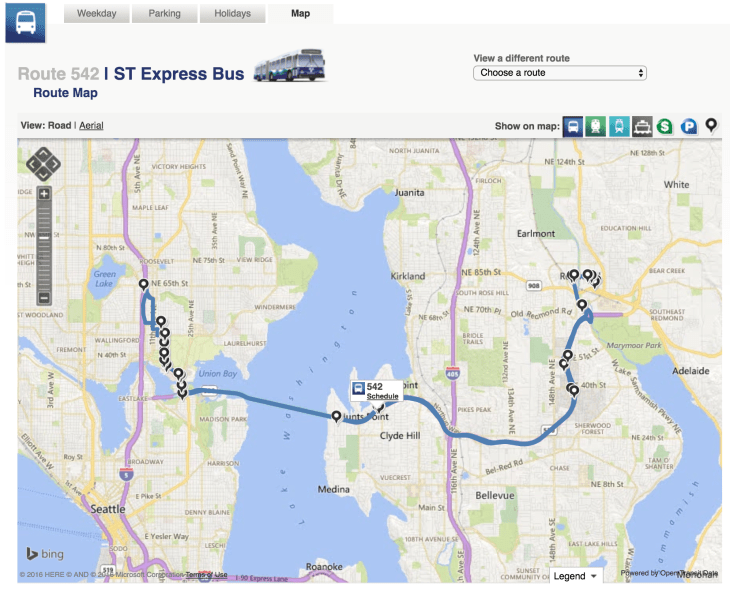
Route 542 – The 542 is almost the same route as the 545 on the east side, starting in Redmond core vs. the Park & Ride like the 545 does. It travels from Redmond TC along the same path to Overlake TC, Evergreen & Yarrow Point and the other stops the 545 makes. It differs as it exist from the 520 Bridge on the west side in Seattle and turns north from Montlake onward to University District and then to the Greenlake Neighborhood area (and Greenlake itself). I’ve used it primarily to get off at University District stop, transfer to the Light Rail, and travel onward to Capital Hill. It’s much faster to do this than it is to actually take the 545 downtown and then bike, walk, take the bus, drive, or use a car share to get to Capital Hill. The light rail connection here is awesome.

References:
Schedule: http://www.soundtransit.org/Schedules/ST-Express-Bus/542
Map: http://www.soundtransit.org/schedules/ST-Express-Bus/542/map140221E3-3405-42D4-9158-78432B4E3768.png
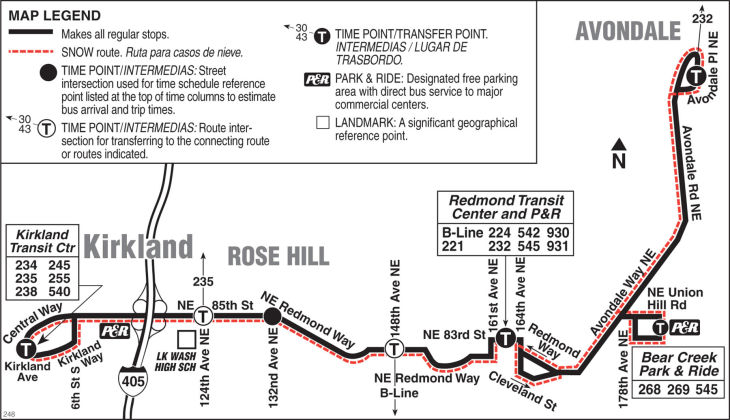
Route 248 – The 248 is basically a connector between town centers. It connects Redmond to Kirkland (More on Kirkland also coming up soon). I’ve had a couple of meetings, that over the last few weeks has led me to board the 248 up over the spine of the hill between Redmond and Kirkland. Biking is almost out of the question as it has two giant issues: One is the higher speed and reckless traffic along the actual routes between Redmond and Kirkland, with little to no decent bicycle infrastructure between the two towns. Second is the fact there’s a giant hill that would require biking up going either direction. This leads to a less than appealing bike route between the two towns, but the 248 perfectly bridges the gap perfectly and quickly. The trip time, at least in my experience, has been between 13-18 minutes depending on traffic. Bringing the bike, that leads me to connect with any point on either side within just a mere 2-3 more minutes within the town center areas.

References:
Schedule: http://kingcounty.gov/depts/transportation/metro/schedules-maps/248.aspx
Map:6DC2D138-49E3-456C-9910-ECD11EE14501.png
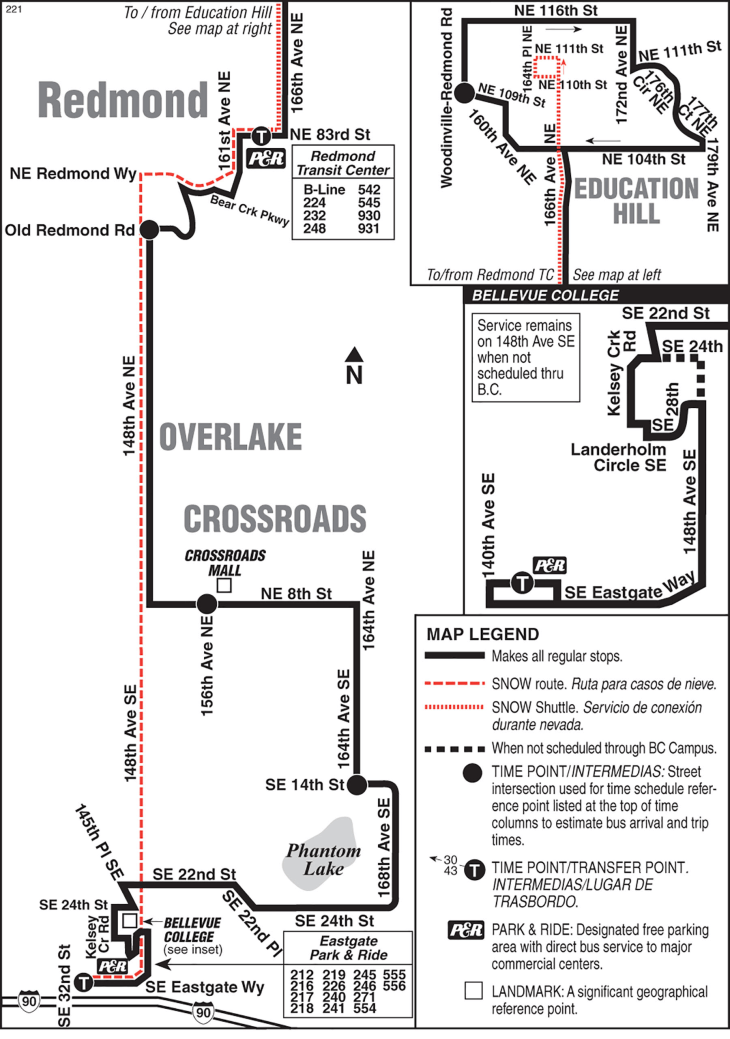
Route 221 – The 221 is an odd route, at least from where I am. It leaves Redmond and returns to Redmond in the morning and then a somewhat circuitous route across the east side to Eastgate Park & Ride. More notably however the bus stops at Bellevue College where a large percentage of riders disembark to attend school there. I’ve taken this route riding with my wife to Microsoft but also to get over to Bellevue to bike into that city.

References:
Schedule: http://kingcounty.gov/depts/transportation/metro/schedules-maps/221.aspx
Map:0A0E3123-D4B5-4028-98F6-EC89BEC6D986.png