Ok, so it seems the names change, so I will kick off this blog entry with a definition of what a greenway is.
Neighborhood Greenways are residential streets with low volumes of auto traffic and low speeds where bicycles and pedestrians are given priority.
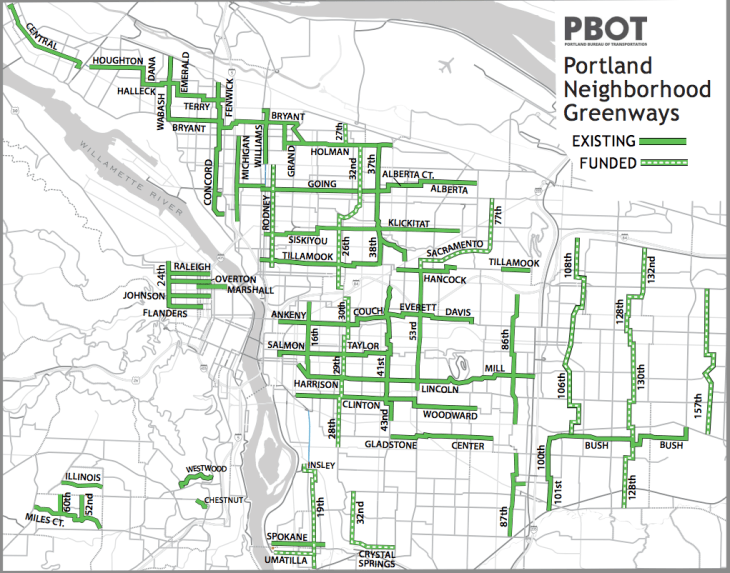
Here is some more information on the Multnomah County Site. I’ve posted a screenshot of the map on that page below.
There’s also a useful video, produced a good while ago, that explains when the bike boulevards became neighborhood greenways.
The goals of these greenways are simple: (PBOT description on the left, my translation on the right)
- Reduce auto cut-through – Reduce dangerous cut-through behavior unfamiliar with neighborhoods endangering people in those neighborhoods.
- Safer cycling and pedestrian connections – Insure motorists don’t kill more pedestrians, cyclists, and those in their homes (not joking, motorists keep running into stationary builds with people inside), and generally create safer ways to get where we all are trying to go.
- Reduce auto speeds – because seriously, slow down on neighborhood streets asshole. Whoops, that was a little aggressive, you get the point.
- Help people cross busier more dangerous streets – Where streets are designed where motorists have killed people, improve the intersections and crossings to prevent motorists from killing more people.
- Provide easier guides on the route – Make it easier to figure out where you’re going, even when you haven’t checked your google maps route. 😉
- Provide more “eyes on the street” – I think this means more people biking and walking means safer streets, as the data proves, as motorists tend to chill out when lots of people are out and about keeping an eye on their bad behavior. Or it just means more people are staring at the street. I’m not 100% sure about this one.
Ok, so now we have a shared understanding of what a greenway is and generally where they are in the Portland city limits.
But where are we now? There are problems…
A few events have taken place in Portland that have led to some pretty serious problems on the greenways that need to be resolved sooner rather than later.
First Event: There have been thousands upon thousands of new residents that have moved to Portland. Hello to all of you that have moved here over the last decade, welcome to the city! That’s all fine and dandy, this has had profound changes on the city – for better or worse – and the one big change I’d like to point out is that this influx of people have led to more people on the streets. It isn’t just cars, but all modes, however the mode taking up the most street space by orders of magnitude that moves less people are — drum roll please — cars, you guessed it. Because of this there is increased traffic. This leads to more people trying to take shortcuts. Taking shortcuts leads me to the next big event…
Second Event: This app called Waze happened. It’s great for the motorist stuck in traffic, but it enables the stuck like a pig in a cage driver to use the road system in a way it WAS NOT PLANNED TO BE USED. A motorist is NOT supposed to be cutting through neighborhoods (at 20mph or 50mph for that matter) to get from one highway or major arterial to another. But this app enables exactly that. It’s made once pleasant and low traffic neighborhood streets (i.e. greenways and such) into traffic sewer bypasses and cut throughs.
Third Event: The economy improved, yay! Good for us, good for you, good all around. It’s a good thing when the economy is enabling us to feed, eat and clothe ourselves along with enjoying life! However there is a dark side to this, because about 49% of trips into downtown Portland are not made by biking, walking, or transit, but by a single person in a single car, which creates a maddening and dangerous rush hour. Every single day the pollution skyrockets and the air quality decreases dramatically because so many people want to drive, drive, drive. So they do, and hey, we’re America land of freedom and stuff so we subsidize the hell out of that and enable as many people as possible to drive… but, a lot of these now employed people are out there driving, using things like Waze, moving here for work, and generally being a motorist sucking up a bunch of space in their private car and dirtying up the air in spite of the other 51% of trips into and out of downtown that are not done in such a selfish way.
So that is the root of our big issues. But now, how do we fix such issues? It’s actually super easy!
Solution #1: Diverters
Physical diverters direct auto traffic out of neighborhoods onto primary arterials where higher speeds and higher throughput of automobiles is possible. Instead of buzzing through neighborhoods for long trips automobiles are sent into the key automobile sewers like Highway 99 (MLK), Highway 26 (Powell), I-5, I-84, I-205 and other main drags like Hawthorne, Cesar Chavez, Rosa Parks, and others.
These diverters do this and make neighborhoods better for those that live in the neighborhood. Diverters make the neighborhood safer for the children, the elderly, and all the rest of us just walking along the sidewalks, biking down the street, crossing to the local neighborhood coffee shop, or otherwise.
Implementing these is the key, there are some, but we’re in desperate need of many more. So many greenways have no diversion and easily fall prey to Waze and turning into a car sewer. Recently my wife and I stopped biking toward our destination and returned home because of the incessant motorists passing (most safely, but some unsafely with unclear motive or going straight, turning, or whatever they’re doing). Many of the motorists were clearly confused about where they were going, how to return to the Interstate (Avenue or I-5) and were overall, clearly perturbed that they’d taken a cut through and ended up getting stuck and routed back toward the road they were already on – stuck in rush hour traffic.
I learned two things, one is that rush hour is not a good time to ride to a location for dinner or drinks unless you’re a confident and fast rider (then you’re just always ahead of the motorists anyway) and two, the bicycle infrastructure leaves cyclists in a position prone to aggressive motorists and motorists are in a position that they’ve put themselves in – in traffic stuck. So in the future, I’d love to see some diverters to keep those aggressive, confused, and perturbed commuting motorists out of the neighborhoods. In the end, it’ll help the motorists and everybody in the neighborhood.
Solution #2: Bikeways, Cycle-tracks (Euro style), and the like need expanded dramatically.
The west side is perfect and can easily take on cycle-tracks and bike ways. But so can downtown Portland and the inner east side (re: river to about 20th should be easy to implement). So far though we’ve fallen short of what we can accomplish. To insure that the greenways can appropriately feed the city and people can bike to and from safely, the greenways need connected by cycle tracks and bikeways. Without we will not be able to go much beyond what we have now. The 8 year olds to the 80 year olds won’t bike. Regardless of the stats, it is simply to scary on the roadways for the somewhat less confident riders.
To summarize, adding real cycle-tracks and bikeways to the major hubs we bike to, would enable the greenways to truly thrive. The planners know it, the stoned guy on the corner knows it, anybody that connects any kind of simple thoughts knows it! The question is, will we act on it as a city and get diverters put in place and get some real greenway connections into and out of the city core. The possibilities are numerous, the only action left is to implement.