Sad, But Good news Maybe?

So maybe the city is going to finally get some diverters and make something happen to reign in the growing dangerous behavior of drivers in Portland. Here’s more info on the matter. I’d love to know what you think on the matter?

…or do I?  Naw, go ahead, throw in some comments on twitter or wherever I’ve posted this and we’ll dive into it.

Whatever you do say, don’t bring up the insane point that drivers are somehow more well behaved than any other type of road user. The evidence is stacked very high against such batshit insane ideas. Just look at those ticketing stats for ONE operation that was publicized.

– 18 Failure to stop and remain stopped for a pedestrian
– 14 Operating a vehicle while using a mobile communication device
– 7 Passing a stopped vehicle at a marked crosswalk
– 2 DWS [Driving While Suspended] (violation)
– 1 DWS (Misdemeanor)
– 1 Careless Driving
– 2 Failure to obey a traffic control device,
– 3 No operator’s license
– 1 No proof of insurance
– 4 Driving uninsured
– 1 Failure to drive within lane
– 1 Operating without proper fenders or mudguards
– 1 Expired registration tags, 1 Obstruction of vehicle windows
– 1 Speeding
– 2 Failure to register vehicle
– 2 warnings

If these tickets actually generated a profit (which if you’re confused about that, they actually don’t because the prices aren’t high enough to cover court costs and related admin duties for the vast majority of them) the city could maintain a self-sustaining traffic division with these kinds of behavior from so many. Mind you, at this rate of citations (and the likelihood many scofflaws were missed) this is still the minority of drivers. Many drivers actually do behave well and many drivers even will stop – as they are legally demanded – and allow you safe passage.

It’s the 15-20% of drivers that behave like scum and villains.  :-/

Seattle to Portland High Speed Rail

One of China's High Speed Rail Stations

One of China’s High Speed Rail Stations

Currently travel times between the heart of Portland and the heart of Seattle look something like this. Google maps reports driving is 2 hours and 44 minutes. That’s with no traffic congestion. Flying theoretically takes 45 minutes, but that isn’t really to Seattle, it’s to SEATAC, which is nowhere near downtown Seattle. Taking the train takes a mind boggling 4 hours.

But seriously, those times are all a bit deceiving. Because of the unreliable nature of American transportation infrastructure and systems we end up with dramatically different averages. Driving is sometimes as low as 2 hours and 15 minutes, but regularly more than 3 hours if either end has traffic congestion. The train, if you take the Amtrak Cascades takes about 3 hours and 30 minutes, but on some rare occasions it actually makes the trip in 2 hours and 55 minutes when there’s no freight congestion. Flying is a joke if you need to get to the downtown core of Seattle or Portland. Getting to either airport from the city core takes somewhere between 20 minutes to an hour or more for each city. Again, it depends on the traffic and the mode. Using light rail on either end is a 30-35 minute trip to get downtown. So in the best case scenario, with arrival at the airport at least 1 hour before take off we’re talking about a 3 hour trip minimum, if not more. Putting air travel head to head with riding the train. There’s also the bus, which can take a variable amount of time but often similar to driving.

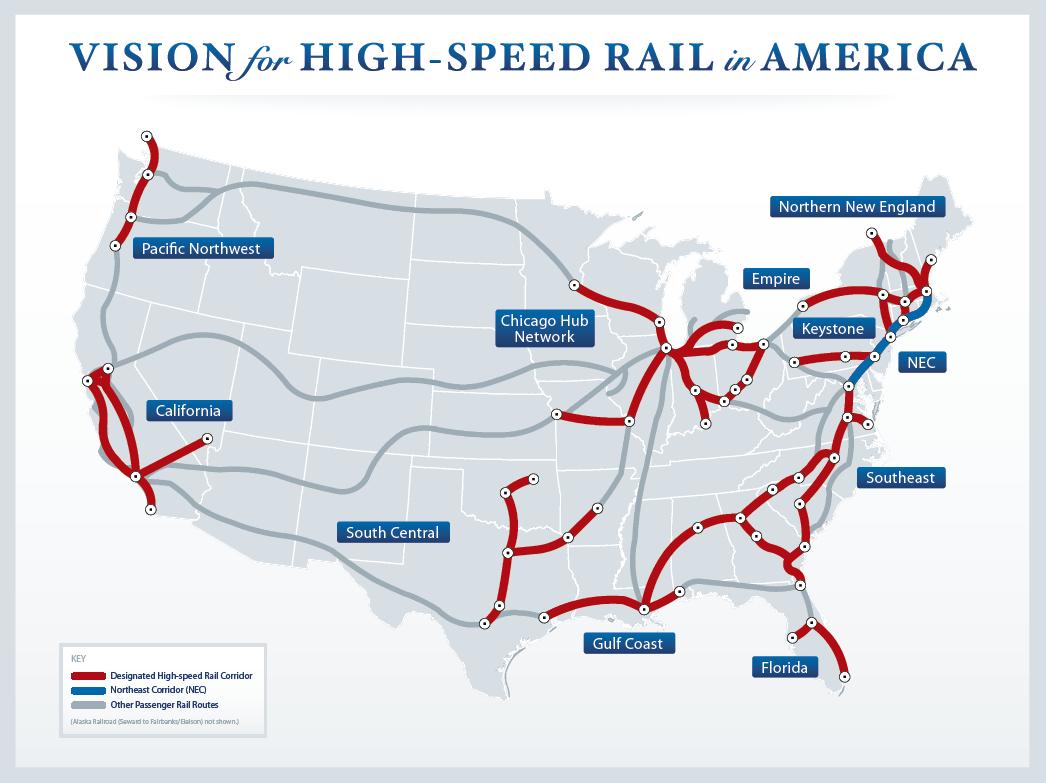
Vision for American High Speed Rail (Click for a great article on American high speed rail)

Vision for American High Speed Rail (Click for a great article on American high speed rail)

Now imagine for a moment if we had real high speed rail service from Union Station to King Street Station in Seattle. At a top speed of 200 mph, with the same stops that are currently in place, the travel time between stations would easily be covered in about an hour an 15 minutes. Maybe plus or minus 10 or 15 minutes. But either way, it would clearly be the fastest way to travel between the cities.

Just think about that type of travel between these cities. Think about what would be possible…

Portland Living, Seattle Jobs

All of a sudden, with a system like that in place it would open up the Seattle job market to thousands of more people in Portland and even introduce the possibility of living in Portland and working in Seattle. That’s a pretty crazy thought when one stops to think about it. A commute from Portland to Seattle would be no more than what a current commute from Tacoma to Seattle is via the Sounder Commuter rail, or some of the express buses from Everett or far eastern Bellevue or Redmond.

Suddenly, Portland would have the possibility of dramatically more business with Seattle, and obviously vice versa. It leaves one with a question of…

Why don’t we have high speed rail between these two cities?

It’s really kind of insane, and is representative of our ongoing paralysis in intelligent economic development between key cities in this country. Portland and Seattle are a prime example of this exact paralysis. The public sector can’t get it done. The private sector isn’t even allowed to touch the notion. It’s pure idiocy all the way down the decision flow.

As I see many people who live in Seattle, who would rather live in Portland, but are stuck living in Seattle because of the better work & career options this high speed rail thought always comes to mind. Also I imagine there are some people that might want to live in Seattle and work in Portland, but probably not. The general crux between these two cities is that Seattle has the good jobs, and Portland has the good life.

Now while you’re thinking that through, just imagine if we really managed to get our act together and include British Columbia and connect Vancouver. We’d effectively move into the realm of a serious powerhouse world class economic region of the world. Livability, jobs, and career options that exceed the rest of North America by many degrees.

I’d wrap up on these thoughts with a simple notion. Let’s kick some serious regional ass and get some high speed rail built. There’s no region we shouldn’t move into the next level in a serious way! It could start with the cities’ mayors getting together to start applying some real pressure on the respective states and nations to get their act together. It’s well past the time we should start building up the Cascadian Region in some serious ways, let’s stop piddling around and make this happen!

Fixing Bicycle Access in Downtown Portland : Time to Get Real

I recently sat reading a Bike Portland blog entry, as I do so often. This one is about a project manage position with the city to work on downtown bike infrastructure. Something that this city, especially with the volume of cycling traffic we have, sorely needs. I started to write a comment, but it got so long I realized I needed to write a blog entry, so here it is…

$6 Million is Not Much For Infrastructure

First off, it’s really great that there is $6 million for this. Albeit if it doesn’t include real separation, then we’re not talking about bike infrastructure for the 8-80 range, which we NEED if we’re to reach the 25% mode split in any millennium, let alone the next 10-20 years.

I’m one of those that doesn’t need serious infrastructure, I just cut around all the cars that are stuck all the time (within limits of 99% of the laws, I stop at stop signs even though motorists scream at me for it sometimes anyway). But I’d love to see the families, the mothers and fathers with children riding. These are actions I’ve only seen previously in places like Amsterdam and Copenhagen or only in inner south east neighborhoods of Portland. Stout children with the fortitude to keep up with their parents, without fear of being slaughtered by errant motorists being negligent while checking the latest twitter retweet (which killed more under 21 persons than anyone wants to ever count). That’s what I’d like to see, something that really ups the level for us all, and moves us past this petty stage of “kinda sorta bike infra” while we pretend we’re wanting people to really treat alternates as a real option to the automobile.

The two routes that immediately come to mind – and one isn’t 12th, not because I agree with the PBA either – is to connect the Waterfront to things that are inside the city streets. That means running something west from the waterfront. Ideal would be to close off the east and west streets that run parallel to the MAX tracks to the stadium (I hear families might like to bike to the soccer games eh?). These two streets, Yamhill and Morrison are already very low traffic streets. Again, as I often say, throw in some bollards for service trucks or emergency access as needed, but keep general traffic out and turn them into true – high grade – bike ways. In addition it would cost how much to do this? Probably 40-50k for bollards and some paint. This is not a lot of money, and fits well within a $6 million allowance. That should provide enough for some decent pavement smoothing, cleanup, and lights to insure smooth flow of traffic for all users.

The other direction, north to south and south to north, is a different story. There are two key locations where a bike way needs to exist. One in the stretch near the waterfront that would move into Old Town / Chinatown and one that would go all the way into the Pearl District. This is a bit more confusing of an area for me personally, but it could easily have one corridor start at PSU following the Park Blocks and one that starts around the infrequently used 3rd and 2nd Avenue Streets.

A third option, which I really think some focus should be honed in on, is the Couch couplet idea, but drop the streetcar notion and focus on breaking it out for a strong pedestrian and cyclist focus. Just close Couch to traffic altogether, put a small flower bed in the center and turn it into a major cycle way with obvious pedestrian access to boot. Put the flower beds at the areas where cars aren’t allowed to turn into anymore and magically, with maybe 50-100k we have a major cycling arterial that could effectively be car free. A perfect corridor for the 8-80 crowd.

Anyway, here’s a few key streets that could be turned into cycle and pedestrian only roads with an absolutely microscopic effect on actual auto traffic flow. They’d be able to line up and queue for inbound and outbound traffic flows with zero traffic changes – because simply, these roads are barely used by automobiles now!

Here’s a few thoughts drawn below… easy to implement, cheap, and barely disruptive. Let’s get this done!
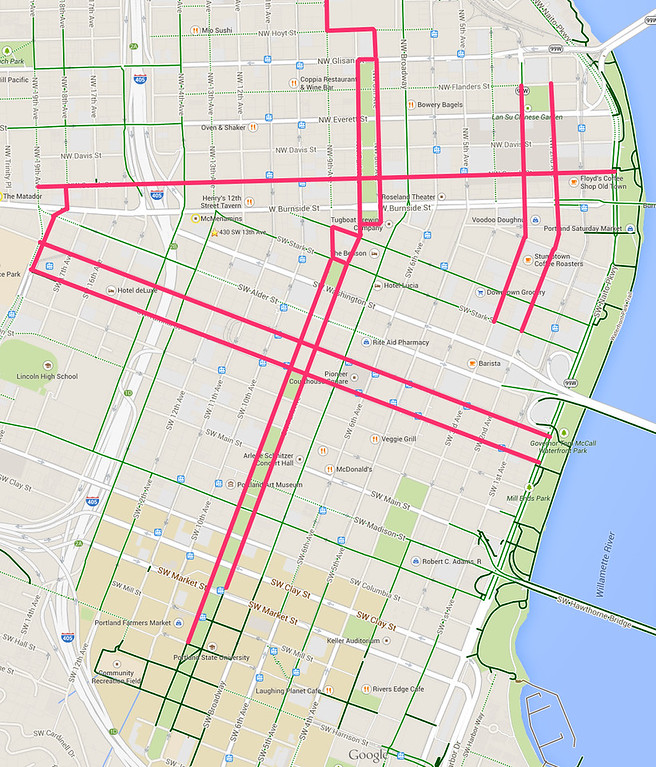
Primary Corridors where dedicated Cycle-Tracks should Exist

Primary Corridors where dedicated Cycle-Tracks should Exist

Looking at the routes above, seriously, after years of living in Portland. These routes would also cause almost zero change in automotive traffic movement and would change so little automotive parking that I’d be largely surprised if 99% of motorists even noticed. Do you see where this would cause much disturbance?

Thoughts from Oakland on Portland, To 2015!

This last week has been a whole host of madness. I’ve tried to kick off the new year with some solid riding, which I’ve been partly successful at. I’ve also started my planning around activism and advocacy for cycling and transit in Portland. There are a number of projects, but the top three I’m aiming to put effort into are as follows:

  1. I’m working with others to begin citizen observation and video recording of traffic scofflaws. Those that ignore diverters and other traffic control devices are on watch. Think of this as a neighborhood watch but with the prospect of actually pressing charges utilizing citizen citations. Those that endanger others through their actions are officially on notice.
  2. I’m trying to figure out a way, and would love any assistance, at figuring out how the city can crowd fund and allow citizen activists to actually help maintain infrastructure amenities. All of those downtrodden bus stops, MAX stations, and other areas that seem to be in disregard – I’d like to find a way that myself and others can volunteer to help out with these amenities.
  3. I’m starting efforts to organize and sustain more regular rides, both cycling and transit rides, that will culminate in various activities that might include: bonfires, camping, hacking (coding), hardware hacking (building cool stuff that does cool things), and possibly hardware build outs (like hacking bikes and building rigs of various sorts).

No bets yet, I hope I’m successful at all three, but I’ll be happy if I can knock out #1 and one of the other two.

Other Network Building & Learning Efforts

I’m also intending to actually meet, face-to-face, a number of individuals that I’ve been aiming to meet for years in the Portland area. Hopefully if I don’t accomplish the later two of my goals above, I can help others knock out a few of their goals for the coming year in activism and advocacy.

For now, cheers, happy new year, and all that jazz.