

I’m sitting in San Francisco right now. Thankful that Portland doesn’t have these political problems or transportation nightmares to deal with. However we have other things that are just as important and dear to our Portland hearts as any of San Francisco’s great political issues.
Warning: There is a free use of language and there are sections that quote data, which may ruffle your features and the safe place you feel you may be in society. I do not apologize at all for that, get over yourself instead. Cheers!
Biking
Biking in Portland has run into a number of issues. From losing its mojo, to losing our bike capital status (or just the sign), to things just generally going wrong. For me, I feel like enough Portlanders have travelled and seen real bicycle cities, and as the news and stories of these great worldly cities comes back it makes any US city look like a transportation catastrophe. It only takes a trip to Amsterdam, Copenhagen, even Krakow (Pt 1, Pt 2), or one of hundreds of European cities to see a system that truly works in comparison to any of the cluster-fucks we call cities in America. San Francisco is a joke, New York putters along, Boston is piddly, and even great Portland seems like biking is merely an afterthought. Everything is focused on the mighty automobile everywhere, fuck anybody and everybody else the moment they step from their iron cage of plastic comfort.
However, amidst and in spite of all this, biking in Portland is still basically as good as it gets in the United States for any major city (there is still Davis, but that’s another story for another time). Seattle is quickly closing the gap, San Francisco – if its mayor would get a spine – would and could likely close the gap, and other places like New York City and even relatively unknown cities like Indianapolis are also closing the gap. Simply put, making bicycling a distant second class citizen to the automobile is hot in America. That’s what I want to talk about here, about Portland, and about making it a truly first class mode in America. How do we do this?
First step isn’t to make driving harder, the first step is to make cycling easy for the 8-90 audience. Grandma that just rocked her 90th birthday should be perfectly safe biking, and not just be safe but feel safe. The same goes for a mother or father letting their 8 year old child go barreling down the street on a bike. Right now, we aren’t even close yet on the “feel” part. Sure, statistically the city of Portland is one of the safest places in America to cycle. It is after all safer to cycle than it is to be in that iron and plastic cage called an automobile. (In turn, note for idiots claiming it’s dangerous to bike a child to school, it is in fact MORE dangerous to drive a child to school in an automobile, matter of fact you endanger your own child AND others even more – so parents don’t even get on that bullshit high horse – those bikey parents are kicking your ass on responsibility and such. If anything ALL parents should give those parents driving their children around a stern eyeing for selling us all short and doing us all a disfavor while endangering everyone, but I digress… another topic for another day)
To make biking this safe, there needs to be real cycle-tracks and protected bike routes (NOT paint PBOT, come on, this is NOT fooling anybody into feeling safe, the uptick is barely a 10% difference on the numbers (just bike commuters), we need a 10% uptick on ALL the numbers (i.e. all commuters)). When I talk about cycle-tracks and bike routes I mean things like this.
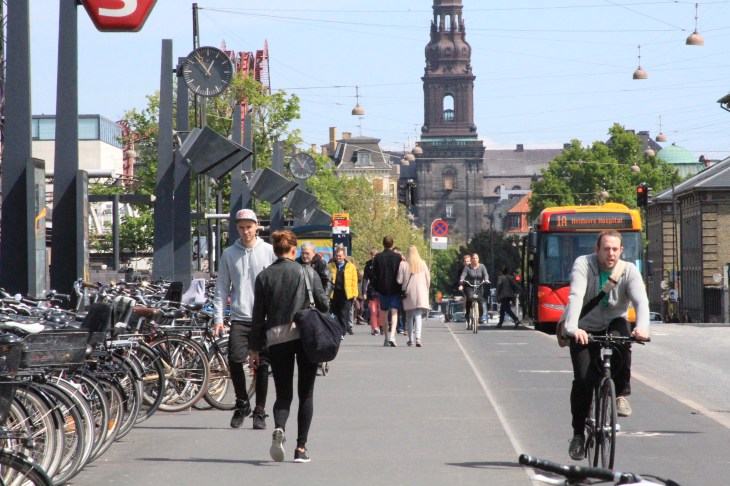
Bike lane, seperated from the road, and the bus doesn’t merge onto the cyclists… note it is boarding passengers at this moment.
There is no need for the bus & cyclists conflict that Trimet forces on us all. It forces us to play the leapfrog nonsense all over the place, when in reality the city and Trimet should work toward better bus stops that allow cyclists to go inside the stop and remove the conflict altogether. Our city and transit officials do us all a disservice by not useing KNOWN SOLUTIONS to resolve this issue. Here’s a prime example of how to build a bike lane & bus stop together that prevents conflicts.
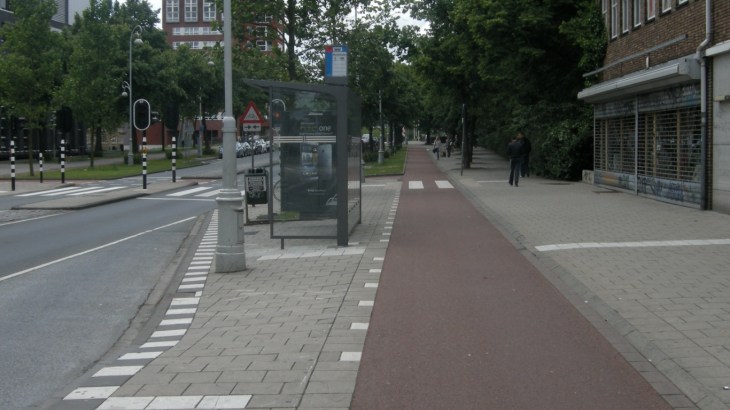
There are many articles on the matter as it’s as easy to implement as a bus stop with a sign! Here in Holland (Amsterdam), the British get it, even Seattle gets it (it’s an article about St Paul with a picture of a Seattle bus stop), and of course we actually understand this in Portland too, here’s two of the bus stops that do it right (out of the thousands of stops we have about 3 that I know of that get it right, get it safe, and remove the conflict)
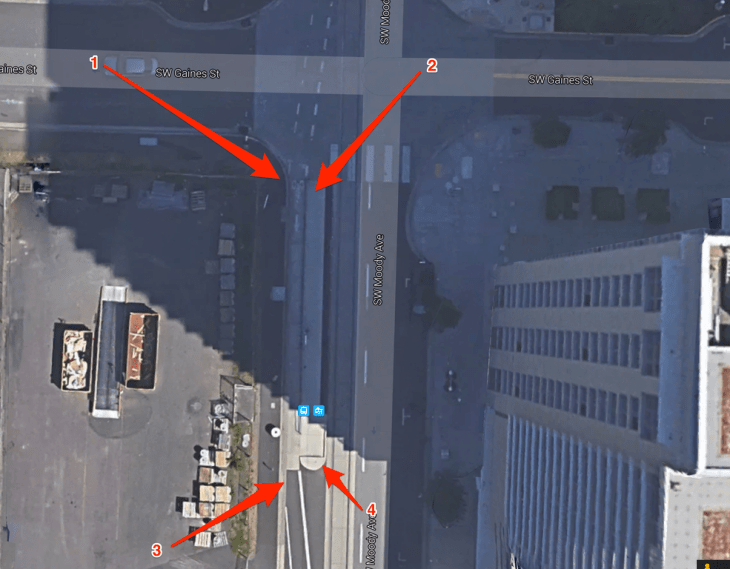
The SW Gaines and Moody Streetcar Stop. Done right.
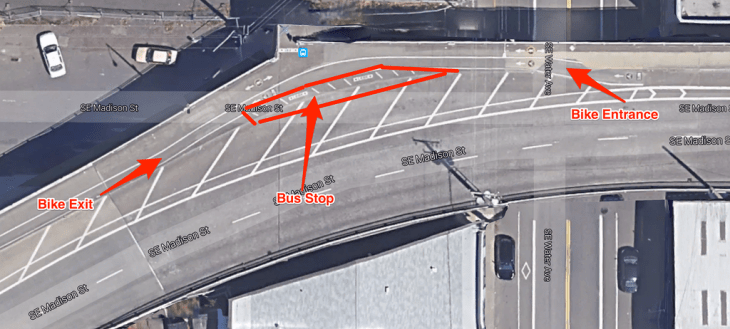
Aerial via of the Hawthorne Bridge (Madison St side) stop that was recently redone to be designed correctly. Conflicts massively reduced now.
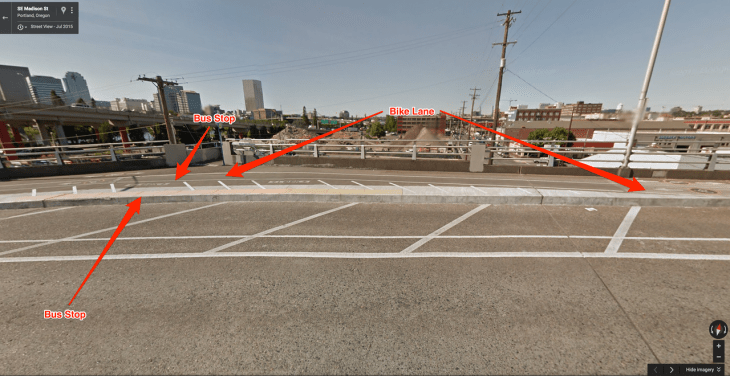
Google Streetview of the same bridge stop. It’s simple, crude, but very fucntional.
Other examples of what cycle tracks and related infrastructure should look like if we intend for the 8-80 (or 8-90) crowd to actually partake. If we want to see 30-40 or even 50% of trips in the city taken by bike, here’s what we need to see for infrastructure.


This shows bike routes, cycle-tracks, and other infrastructure mixing in suburban environments, urban environments, and amidst transit, pedestrians, and more. Below are a few more of seperated infrastructure, clear paths, and related bicycling options as seen in Amsterdam.


It’s easy to do, it is not a complicated thing. We, in Portland as Portlanders, can do this but we have to actually do the work. We have to fight for and get this put into the standard way we build infrastructure. Bicycle infrastructre needs to stop being some secondary modal option and be a priority premier choice that it is.
Transit
The second thing we need to get straight in Portland is a double edged sword. Transit is expensive (often as expensive as buying everybody private automobiles) but for an urban environment is generally worth the expenditure in every way. It pollutes the air less, doesn’t require thousands upon thousands of square feet for parking or multi-story parking garages wasting space in the urban core, and the list of benefits continues. There are however a list of benefits that US transit doesn’t benefit from that it should, that much of our European counterpart cities do benefit from. Let’s talk about how to remedy that for Portland. I won’t talk about how Europeans do it, just how we can fix it up spiffy in Portland. These are a few, and the most high priority, of the items Trimet and the city of Portlland need to work on.
Transit Priority & Reliability
This is a huge issue I have and I know about every single other rider in the system has right now. Buses and trains simply do not show up on time, or simply do not show up. On top of that they’re often randomly delayed throughout the day. Buses of course have little that can be done to fix their timeliness, as they’re held to the whim of the automobile and the selfish single occupant vehicle being operated by the single motorist. The trains are often delayed these days because of reasons ranging from “it broke down” to “something flooded because the drain wasn’t cleared” to “ugh, we’ve no idea what’s going on”.
The later excuses are unacceptable, but also giving priority to automobiles over transit is also just as unacceptable. Honestly, giving priority to automobiles over transit isn’t just unacceptable, it’s downright ignorant and stupid. We can do better and should do better. So this boils down to two major solutions that need implemented.
- The MAX infrastructure needs brought up to a good state of repair. Once it is brought up to a good state of repair, the MAX System should be held to at least a 95% of better on time arrival.
- The bus system should have more lanes and light priority to circumvent the cluster-fuck called automobile dependence. Transit users (and anybody else) not in a car shouldn’t suffer because of the massive number of selfish SOV motorists out there clogging up the roadway. We can’t continue to build or prioritize these people.
Frequency and Connectivity
Currently the frequent service routes in Portland run every 15 minutes, and some routes during a very narrow band of time (re: rush hours) run at a greater frequency than 15 minutes. We need to fund better frequency than that if we want to actually provide a real alternate and realistic option for people to stop being SOV motorists. Currently, I can’t even blame about half of them, selfish or not it is there only choice because transit simply isn’t frequent or reliable enough to utilize right now. This absolutely must change if people are to be expected to change their horrible auto-dependent habits.
We can and should do this, it’ll take some funding, albeit a very small amount, espeically if Trimet will ever get it’s coordination and funding straightened out. A small 0.001% or 0.002% addition to what they currently collect on the income tax would likely be enough to bump up almost every single major route that is currently at 15 minute frequencies to 7-10 minute headways instead. This would be huge for ridership and efficiency. However I will admit, before this can be done we have to do something about the reliability of vehicles arriving on time based on the current scheduling. Currently it does no good to add frequencies if everything will just get bunched up.
The later part of increasing frequency and connectivity is getting that connectivity done right. This is something that should and could be improved dramatically by insuring better transfers and in some cases, reducing transfers by extending, enabling more coverage in routes that already exist. Transfers decrease ridership in a huge way, nobody likes to transfer, especially with our current transfers which are usually ridiculously bad. Especially from routes that are not frequent. If need be some routes should hold, to insure that the connectivity with freuencies 20 minutes or more don’t get disconnected. Those are the transfers, that when they fail to meet, end up making another SOV motorist instead of a transit rider. We need these to complete, every single time they need to complete.
Connecting Towns & Neighborhood Cores
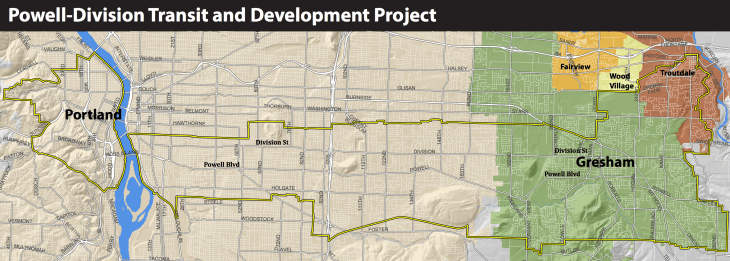
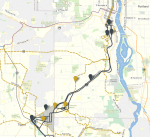 Tigard, Beaverton, Gresham, Hillsboro, and other town cores are connected (some of this is in the works for the southwest and the Powell & Division Corridor). However many neighborhood cores are not connected yet. We still need these core areas to have reasonable transfer points and criss-crossed transit service connecting them.
Take for example Alberta, it has great service from the 72, that connects in a somewhat reasonable way to the 8, 17, 75, and some others. However Alberta Street is under threat of losing the 72 and the 72 instead going down Killingsworth. Compounding this horrible idea is that the bus stops for the 72 are enhanced, beautiful, and artfully rebuilt transit stops. This would be a horrible loss for Alberta Street. The 72 should stay in place and if anything, Killingsworth should just get some of it’s own service.
Some of the many other things are covered pretty well on Trimet’s Website. Most are not resolving the major issues listed above, but instead great ideas for what they can do with what they have. That’s great, but we need to push for better transit solutions if we’re really expecting to clean up Portland, provide a better future for the children of today, or if we’re just fine with shit standards and just above sub-par baselines that US Cities tend to have. I think we can do better, dramatically better, and I’m going to pushing for such in any and every way that I can. I hope to meet and see you all out there pushing for a better future for Portland (and its surrounding metro area – re: Hillsboro, Gresham, Beaverton, Tigard, Vancouver, etc)
In closing, if we want to really improve our city and decreases our auto-dependency and increase our standard of living, the options are simple:
- Make biking a top tier modal option. No more second class citizen nonsense.
- Improve transit priority to top tier mode, and give priority to it over other modes – let it move more people in a timely way.
- Make transit reliable and frequent with reasonable and numerous connections.
That’s it, three major changes. Cheers!
…and of course, I’d love to know if you’ve any other ideas of what should be fixed. Also anything about what can be fixed with what we have at our disposal today, how can we push Trimet and Portland to have better transit and biking service and infrastructure?




 Transit Sleuth