Unknown's avatar

Posts by Adron

See: http://compositecode.blog/about

Portland’s Light Rail Advocates

There are a number of people types when it comes to light rail in Portland. I’ve set out to put together a view of those types. First off, I’ll describe the two types I find myself fitting into.

Backbone Advocates” – Ideal: Light Rail is a great arterial back bone for a transit system.

These advocates see light rail as a great core service provider for moderate to heavy use lines. They’re often likely to want light rail (LRT) over bus rapid transit (BRT) in almost every scenario. The key reason, is because growth can congregate around light rail far better than almost every other bus option. A backbone advocate is also dramatically less likely to use a bus over or in lieu of light rail.

Cycling Transit Advocates” – Ideal: Light Rail are useful, buses are a pain, I’d rather just bike.

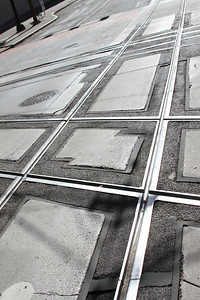
Ok, this category I fall into a lot. Buses are effectively useless and dangerous to cyclists. More so than the tracks in the street. Buses have been the vehicles that have killed almost a dozen of cyclists over the last decade. Many of them children, 5-12 years old. Beyond that, the bus carries two cycles at the most. None of the bus drivers barely know a thing about placing cycles on board. So effectively a bus carries 2 cycles, light rail – a one car train – can carry 4 on racks, and almost a total of 4-6 in between the entrances in the open area for a grand total of 8-10 per car. Most light rail runs with 2 cars, giving a total of 16-20 bikes per train. Buses can’t even remotely touch this. The last fact is simple – streetcars and light rail don’t merge onto you when you’re biking. That makes the rail based streetcar or light rail option the only real transit option for cyclists.

Derp Advocates” – Ideal: Light rail is nifty, I like the way it looks.

These advocates love light rail. They’re not sure they know why they like light rail, but they like it. They like how it feels and they feel X, Y or Z about it but usually can’t back up any of those reasons. These are the people that vote for light rail, and want it because it’s green or it looks pretty or some other non-functional, not really true reason to want light rail, but they love it anyway. These advocates are useful for their votes for light rail, but politically they’re as detrimental to light rail as any other thing someone may advocate for. Basically these advocates are the urbanized version of a dumb red neck that thinks the highways are part of the free-market.
Numbers Advocate” – Ideal: I can statistically prove why light rail is the superior option.

These advocates don’t care about passion or how one feels about something, they’re here to prove everybody else wrong and those that oppose light rail just can’t do simple math. They’re often harsh and introverted to the extreme. These advocates are huge political help when light rail comes up against the “it’s too expensive” or “it doesn’t carry enough people” or whatever other nonsense someone comes up with. These advocates are the ones who do analysis on every single thing they can find. Very useful for bringing up the argument of what light rail really does for a city, but not someone to advocate in front of the camera.

Car Hater Advocate” – Ideal: It aint a car, build it. End of story.

This advocate is simple. Sometimes a cyclist, sometimes a curmudgeon, or whatever they may be they are against anything car related. They often have a host of reasons, all very legitimate, but something society just can’t face no matter how true they are. This advocate doesn’t care how expensive a line gets, doesn’t care if it messes up existing traffic, and only cares about getting the line built. These advocates are politically damaging but often bring with them a number of other staunch advocates in the above categories.

Common (Wo)Man Advocates” – Ideal: I’ve analyzed what data I could find, looked at the benefits and negatives and this seems like a great option.

These advocates are the most important, politically and for ridership reasons. They are the people who will be the core ridership of the line and also will make a line politically feasible or not by discussing and carrying on conversation to build political momentum for a line. They may come to community meetings, they may not, but they’ll be talking about light rail at coffee shops, in the office, over the water cooler and anywhere else the topic comes up. They’ll talk about the pros and cons of the line and say they lean toward building light rail and riding light rail.

I Hate Traffic Light Rail Advocate” – Ideal: If they build other stuff for other people to ride on then I won’t have to deal with as much traffic when I drive.

This is the hypocrite, yet very important ally in the battle to get light rail transit systems built. These advocates, albeit horribly misguided in their notions of what does or doesn’t create traffic, are key in winning votes to get light rail built. Even with the facts around human behavior and induced demand, these advocates have some odd idea that transit will resolve the idiocy and failure of auto dependent roadways.

Summary

So this is kind of the bullet list of light rail advocates. Are there others? What’s your take? In a subsequent entry I’ll post the light rail haters list. It’ll follow the same basic premise. If you have any suggestions for those, let me know your feedback on that too, it’d be much appreciated!  😉

I’m Sitting There Looking at a Dog and Then BOOM, I’m Shredding on a Surly 1×1 Custom

I boarded the #72 heading west at 7th and Alberta. A nice enough day, not cold, but by no means warm. I rode out and got off at the Killingsworth & Interstate Ave intersection to transfer to the MAX Yellow Line. There I took the MAX one stop to one of my favorite coffee shops, Arbor Lodge (If you’re curious, check out my previous blog entry). While sitting there sipping on my coffee this dog and I started a contest, looking at each other.

The Dog's Gaze

The Dog’s Gaze

He sat chilling in the car outside just looking, waiting and ready to go. There in front of him sat some bikes on the sidewalk. As cyclists went by he looked longingly at them freely traveling around and people walking about. The dog’s driver came out after getting a cup of coffee and he became exceedingly happy. I thought, “heh, that dog is reminding me, staring at those bikes that I need to get that second ride so that when my brother arrives in a few weeks, we’ve got wheels to roll on”.

Some of you might think, “why not rent a bike, there are plenty in Portland”. Well, my brother and I grew up riding. We didn’t just ride bikes like most kids, we rode hard. We rode really hard, breaking frames, handlebars, rims, shredding tires and in the process sometimes ourselves. We loved riding, and one things we haven’t whimsically tossed aside is our penchant to live live hard and fast, and to its fullest! We’ve never been inclined to half ass something or have something be mediocre.

So when he comes to town, we’ll have proper bikes, for a proper ride. We’ll have no qualms hitting the trails or hitting the street, dive into some hard twisting roads or whatever might be before us. Because when we ride, we don’t intend to have fear step in front of us for some piddly threatening, we’d just as well smash it asunder as we always have in the past. This way, picking up a second quality bike insures we have the appropriate rides ready, maintained, tuned and rolling for our tour about town.

With that, I decided to walk around the corner as soon as I took lunch, I’d walk around the corner to Revolver Bikes. If they had the bike I’d scoped out a few days earlier I’d pick it up. As with any bike shop, I’d gone in, chit chatted with some of the crew in the shop to determine if they were knowledgeable, friendly and the regular criteria of a shop I’d be interested in coming back to after I purchased a bike from them. Well, they came off as a great team with a fair select of trail, BMC, track and other bikes. But more importantly, in addition to their jovial chit chat & good knowledge, was the nice custom parts they’d assembled on several of the bike setups. Both BMX rides & street, trail and others looked good. So I was sold, lunch arrived and I walked over.

Fortunately for me, the bike I’d seen and wanted was there. I walked in and tossed them my messenger bag & ID as collateral and went for a ride. The bike rode well, just as they’d set it up. A few tweaks probably would help over time but for the moment it was excellent. Except for one thing. The original pedals were plasticy wierdness. Not as grippy as I wanted. When I rolled back into the shop I immediately checked out some options they had on hand. Ended up with a sick pair of pedals with removable pins, excellent grip and thin and wide. Just right for my stomper feet.

No Brooks Saddle, but all the other bits are just right!

No Brooks Saddle, but all the other bits are just right!

With that, I paid, mounted up and headed into town. A short 4.3 Kilometers later I’d arrived and gave a little urban break in session to it. The only question left in my mind, is what’s my new bike’s nick name?

Changes on Transit Sleuth, Bike Much?

Well, as many that know me likely know already, I bike as much or more than I use transit. Basically, it’s easier to just say – I use all modes, with cars being the least used at about 1% or less of my trips. In the last 3 years I can count the uses of a car on one hand (i.e. < 5). I’ve used a truck (U-Haul) twice. Transit ranges in the 600-700 trips per year (i.e. counting each boarding) range, with some previous years ranging between 800-1100 per year. For passenger rail I’ve made approximately 50-90 trips per year (including 500+ mile long distance trips and shorter hauls such as between Seattle & Portland).

My main mode is absolutely my bicycle. I’ve made about 900 trips or rides per year, excluding 2010 when I actually went an entire year without a bike. It was a strange and surreal experience. I imagine it was what an auto-dependent person would feel like without a car, but I can’t really relate as I’ve always been pretty autonomous of my past cars.

Alas, Changes to Transit Sleuth

So why am I going on about this? Well, that’s actually somewhat simple. I’m going to be changing the topic space on this blog a little bit. It’s going to range more extensively from transit to bicycling. I’m going to make a point to focus on how those two modes bridge gaps for each other and amenities, lifestyle, livability and related topics around biking and transit use.

So with that… this blog entry is my official date stamp for starting a new blogging effort.

Automobiles Are Great!

This started as a comment, mostly motived from this blog entry “the thing about guns“. This entry however has nothing to do with guns, but one of our other massively glaring problems in society here in the United States. This is the remark that brought this up…

“If roads were collapsing all across the United States, killing dozens of drivers, we would surely see that as a moment to talk about what we could do to keep roads from collapsing….Only with gun violence do we respond to repeated tragedies by saying that mourning is acceptable but discussing how to prevent more tragedies is not.”

Actually the US is really bad at that too. The feds spend 3% of the budget on roads, then another 3% in incurring debt to build roads. Then the other 50% of those road project costs are put on the states. Thus, the feds start huge road projects and then bum them off to those least able to pay for it. These road projects, surprising are only the Interstates.

Now step into the other road situation, all the local roads and highways. Responsibilities of states & cities/counties. That’s usually 5-10% of their budget, which taken in totality, means the country spends far more than 3% on this just from taxes – combine the city, state, and federal budgets and you have a massive amount of money spent to make car usage easier. Why do I bring all this up? Because the Us continues to perpetuate this as a “market driven choice” and it is in fact absolutely not. What does this choice bring us?

  • Dramatically higher incidents of cancer. Which kills dozens of thousands of people every year.
  • Dramatically higher incidents of benzine poisoning. Which also kills thousands and thousands every year.
  • Dramatically higher incidents of poisoning. Which kills dozens of thousands of people every year.
  • Pedestrians are endangered by our general road designs, which some places are fixing, but not many. Add several thousand more dead people. This is often children, elderly, and others while simply playing or slipping slightly into a roadway in a neighborhood or off a sidewalk. Something that should and could be entirely prevented.

That’s just the beginning. The small beginning mentioning just a few issues of our auto-dependency and the fact the US completely ignores it as a MAJOR problem. This little list above is just the things that can be directly correlated and connected to automobile usage, primarily of the combustion driven kind. Maybe some things will decrease when we get more electric vehicles out there such as cancer, benzine and poisoning. One can hope. But let’s not stop there.

Last year over 33k people were killed in cars. The year before that, 36k and the year before that 32k and before that 34k and before that… you get the point. Since the 1920s the deaths have gone up and stayed between 21k-62k per year. Direct, crash related deaths. Per capita they’ve decreased, which is good, but we still exceed 30k per year. Which means over the years, millions have been killed prematurely, a great majority of those people are young people too. More… http://en.wikipedia.org/wiki/List_of_motor_vehicle_deaths_in_U.S._by_year

That doesn’t include the 5k+ dead pedestrians every year or the 1k killed in unrelated incidents with cars every year that are still directly related to some form or another of crash.

Let’s take on another statistic. I’ve just been talking about the people who now lie dead. The dozens of thousands of dead per year, that sometimes die quickly and sometimes die agonizingly slow deaths. But what about the 3-5x as many people who are now on disability because of an automobile related incident? The now maimed, forever on disability. These people who are missing legs, arms, fingers, or worse. The two ladies waiting at a street corner, entirely innocent who were slammed into by an out of control cabbie. Lost their legs, laid screaming for help on the sidewalk after in traumatic pain and suffering. Because of one negligent fool. Now forever damned to be disabled for no reason. Well over 90k people per year are added to these ranks every year in the United States. Totally billions of dollars in costs to the medical system & taxpayers. A horrible toll for a war let alone merely trying to live one’s life. But alas, this happens and continues, unabated in every part of the United States.

All of these stats point to a massive death count, there are few things that kill more people in the United States than the automobile & it’s use. All of these stats also don’t even reach into the outer affects of auto dependency, our necessity to “stabilize” regions where oil is found. The destruction that happens because of that industry, but I won’t go on about those thousands, hundreds of thousands, or hell – millions of people that are dead because of that. But one can assuredly know they are in large part related to the United States’ obsession with the automobile.

So in the end, that’s a lot of writing I did. Which I do like to write, and research, but the whole point of this is. The United States is notoriously bad at not fixing very obvious problems. Roadways, automobiles and related killings and permanently disabling people are a prime example. Hopefully, one day the United States starts to wake up to this massive problem.

Just wanted to put throw in two cents, and put the gun violence problem into perspective. It’s a very small part of the absolutely massive issue the United States continues to ignore every day. The United States, simply, needs to get more focused on living & working better. Because right now, we’re really falling behind the developed nations of the world in huge ways.