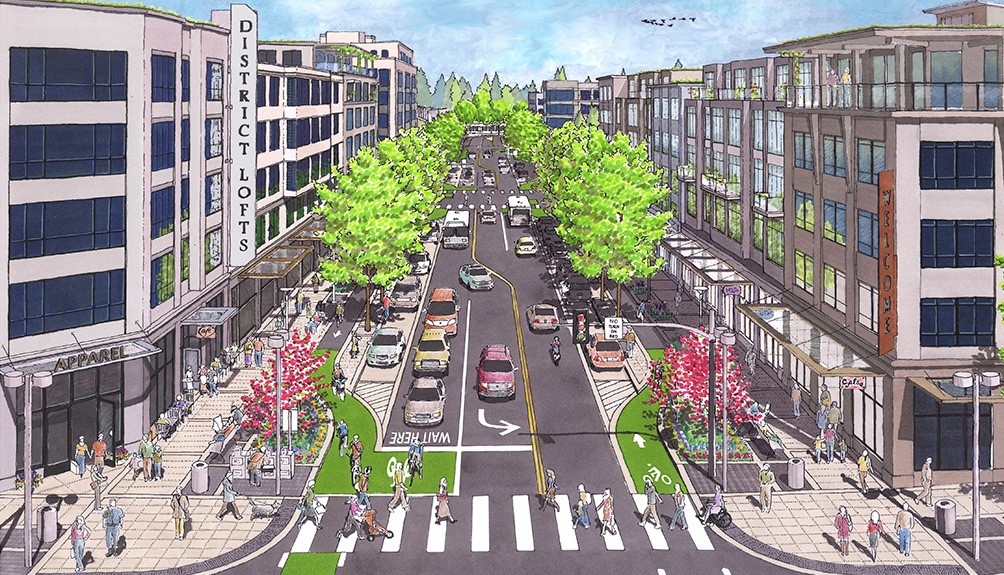
Trying to Save Redmond from Its Auto-Obsessed Past – Exploring the 152nd Street and Overlake Area Projects: A Vision for Redmond’s Future

Redmond and Bellevue, long synonymous with sprawling parking lots and endless highways, vertical spines of suburban hoity toity tasteless strip malls, are finally trying to shake off their addiction to the automobile. The new projects around 152nd Avenue NE, 156th Cycle Track, and Overlake Village Infrastructure are touted as the next big thing in making the area “livable”—because clearly, we’ve all been loving those car-infested corridors so much that it took decades to realize something was off. Here’s a look at the “ambitious” plans to reclaim some humanity from the asphalt wilderness.

152nd Avenue NE Main Street: The Quest for a Pedestrian’s Paradise in Car-Land
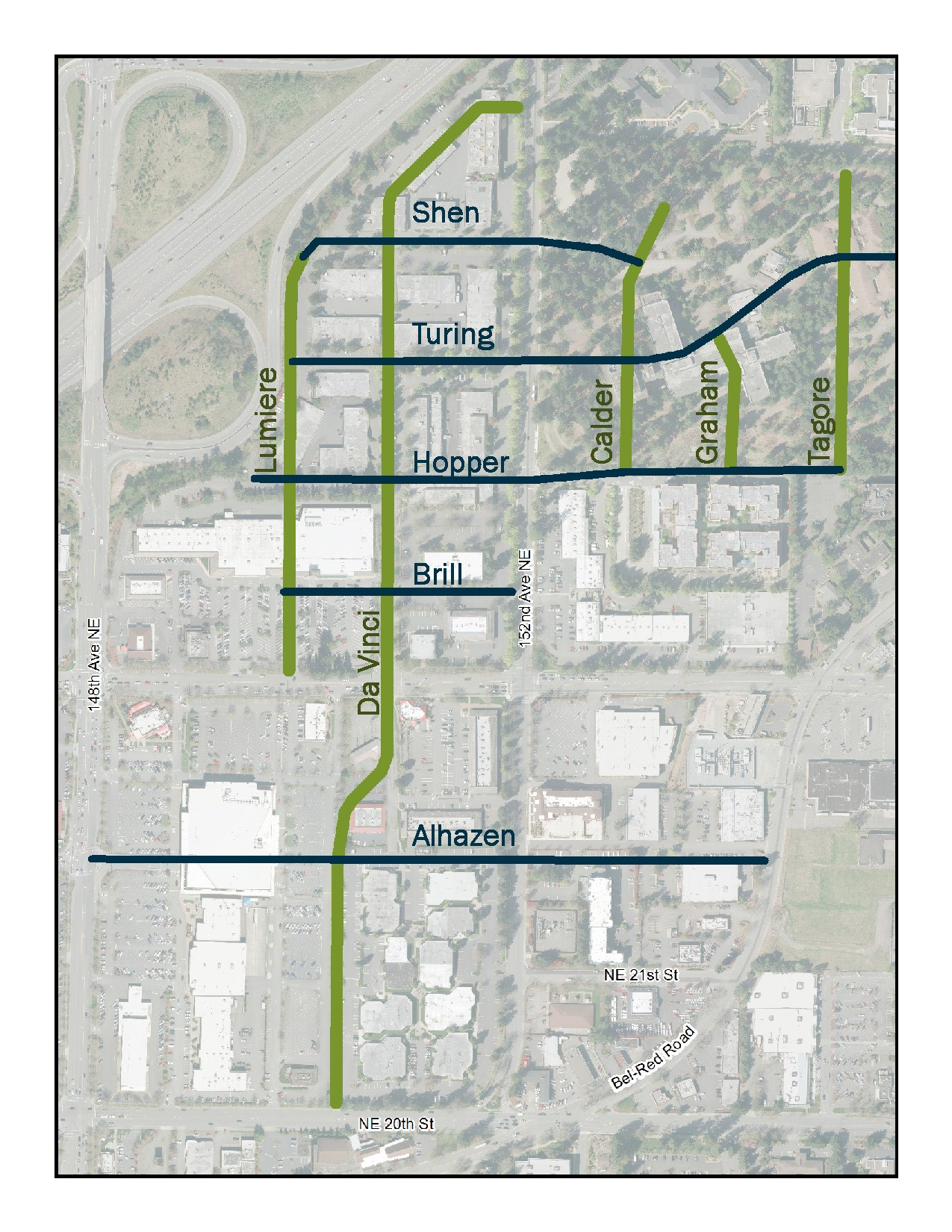
The 152nd Avenue NE Main Street project aims to turn a once soul-crushing stretch of road into something “pedestrian-friendly.” Imagine that: walking down a street where you’re not just waiting for a crosswalk signal like it’s an act of divine mercy. This project will roll out wider sidewalks, because, surprise, people do actually walk, and protected bike lanes, because it turns out bikes aren’t just a relic of the past. In addition, they intend to put in place an actual street grid like a real city!

The city planners are throwing in some landscaping and public art—likely to distract us from the decades of prioritizing cars over community. And yes, we’ll get street lighting that’s more than just the sad, dim bulbs that currently light up the vast emptiness of parking lots. It’s a bold move to try and inject some vibrancy into a street where, up until now, “scenic” meant looking at the back of someone’s SUV.

156th Cycle Track: Because Cyclists Deserve Better than Dodging Cars

For the brave souls who dare to bike in a city built for cars, the 156th Cycle Track is the beacon of hope we’ve been waiting for—or at least, it’s supposed to be. This project is designed to give cyclists a protected road of their own in this segment, so they no longer have to rely on sheer willpower and the kindness of strangers motoring around in their cages to avoid becoming roadkill.

The cycle track will connect the SR 520 Trail to Overlake Village, finally giving cyclists a direct route that doesn’t involve navigating a gauntlet of speeding vehicles and poorly timed traffic lights. It’s almost like the city realized that people might choose bikes over cars if they didn’t fear for their lives. What a concept.

Overlake Village Infrastructure Planning: Patching Up the Auto-Dependent Mess

And then there’s the Overlake Village Infrastructure Planning—an initiative that sounds like it’s about fixing the glaring oversights of a car-centric past. This grand plan includes stormwater management (because, who knew, we need to deal with rain too), better transit access (since our existing bus stops on the side of highways aren’t exactly welcoming), and—wait for it—parks and green spaces. Because after all that asphalt, we could use a little green, right?

This plan is also about encouraging “transit-oriented development,” which is urban planner speak for “we messed up by spreading everything too far apart.” They’re now trying to fix it by building closer to transit hubs, a move that might finally give some residents the option to not drive everywhere—because clearly, parking lots as the centerpiece of community life didn’t turn out so well.

The Grim Reality: A Half-Hearted Attempt to Undo the Car-Centric Damage

These projects, despite their promises, can’t quite hide the fact that they’re desperately trying to undo decades of car-centric planning. The efforts to add pedestrian paths, bike lanes, and transit-oriented development feel a bit like putting a band-aid on a gaping gunshot wound, but hey, it’s better than nothing.

If you’re in the area, why not check out these efforts to bring some life back into the auto-dependent wasteland that we’ve built? Take a walk down 152nd Avenue, if you dare, or brave the cycle track. Maybe, just maybe, we’ll see the day when Redmond and Bellevue aren’t defined by their endless stretches of road, but by the vibrant, connected communities they’re trying so hard to become—one sidewalk and active transport corridor at a time!

Here are the key links to the projects mentioned in the blog post:

  1. 152nd Avenue NE Main Street Project:
  2. 156th Cycle Track Project:
  3. Overlake Village Infrastructure Planning:

Economic Suicide

Per this link, more and more Americans are 60 days behind on their cars, a depreciating asset that is losing value at the same time.

Keeping it up, it’s economic suicide to continue our auto-dependent society in its current state.

Americans, are literally building themselves into a debt implosion of financial servitude. Auto-dependency and relying on a massive industry – which too often requires bail outs in the billions and billions of dollars – to support a debt based economy with an asset depreciating product (the cars) is economically suicidal on a vast scale. It is ensuring that everything from quality of life, to tax revenues, is sure to continue to decrease.

Meanwhile the US has built our entire system around a debt based fiat currency with depreciating assets everywhere, with the vast majority of people not building any kind of personal wealth, let alone generational wealth.

Are there any efforts to curb this? We shouldn’t be building our society around something that ensures economic self-destruction and servitude for so many in society. The car mythically is touted as a freedom machine, but it’s really anything but.

Solutions?

Obviously people that have been watching this suburban, auto-dependent, economic suicide of suburbia and auto-dependent areas of the United States know this is happening. But we’ve continued to be suckered into suburbia and auto-dependency as a nation. The losses are staggering, and the destruction of personal wealth and generational wealth is almost total for most Americans.

For more details on the absolute economic suicide of “suburbs” and “auto-dependency” here are a few great videos – that are rather entertaining – that explain the situation;

If you want clued into how markets are going to implode, how American society must rebuild itself, and what is coming in the coming years and decades in the United States – these are MUST WATCH videos. They explain it better than I have ever managed to. More on this economic suicide in future posts, but for now, WATCH THE VIDEOS!

Post Wreck Thoughts on 501, PTC, US Liability, and America’s Failing Transportation

I’m already looking forward to healing, obviously, and getting back on the bike. I look forward to riding back to King Street Station, getting on the train and handing off my bike for a station hand to rack on the train. Then rolling, minus a derailment, onward toward Portland to spend time with family and friends biking around town and enjoying one of the greatest, more human, pedestrian friendly, and foodie cities in this great nation. I don’t fear, fate has its hand in what it will hand me, but I can’t live with fear and worry, uncertainty, and doubt. I look forward and am beyond just thankful that I will live to ride this trip again.

In the meantime; Amtrak, Sound TransitWashington Department of Transportation (WSDOT), and Oregon Department of Transportation get y’alls asses in gear and get that PTC working, ensure those engineers really, truly, 100% know that line and please get this service running back at 100%! It’s too important to thousands of people to let falter!

New Information, Thoughts on PTC

As I should have expected, BNSF actually has the PTC up and running on their lines. Amtrak trains don’t have PTC on in cabs as far as I’ve learned. If anybody has more information about this please let me know, I’d love to get more details on the matter. I’ve started researching more about PTC too and trying to determine what exactly is the issue and complexity of the system beyond merely the cost. I know that’s as much a red herring as it is a legitimate excuse. PTC is in place in so many places on so many lines that there’s not a lot of functional excuse, except I bet there’s a lot of bullshit regulation and related bureaucratic mess in the way of the railroads getting this implemented.

The money, also something put totally on the backs of the railroads, hasn’t exactly been easy to invest in as they do have to stay sustainable (the freight railroads). Meanwhile, Amtrak which like all modes of transportation (cars, buses, places, etc) is entirely not sustainable from its current state of legislative ecosystem (meaning the way it must account for costs, revenue, systemic matters of stations, debt, etc).

Health Insurance, America Fails Americans Miserably

Another major issue here, that slams all transportation modes, is in insurance claim scenarios like this an incident is liable to entirely destroy a company that operates passenger service. In European countries people that are injured are covered under national health care policies and plans, and lawsuits and liability insurance help to rebuild and make the railroad (or airline, ship, or roadway) better after an incident. Instead in the United States, except for the cap placed by Congress in 1997, Amtrak has its budget wrecked by lawsuits and the need to cover people’s medical costs. Airlines suffer a similar fate if not careful. The problem is, there’s always accidents, but a passenger system shouldn’t be destroyed by lawsuits because of a singular accident, it should be fixed and rebuilt better, safer, and stronger.

In America, we simply do not do this anymore. Our actions instead tend toward destroying a large singular entity with litigation; such as Amtrak, an airline, or bus carrier, while with distributed incidents like the almost 40,000 deaths per year in automobiles, we simple push the cost back onto insurance and individual owners and purchasers. The latter works to perpetuate the most deadly of transportation modes (automobiles) while it defers, damages, and arguably makes the safer modes (buses, trains, planes, shits, etc) harder to operate, manage, and make safe. It’s a perverse and backwards effect that we get, but something that could be remedied with a simple fix.

Instate some form of national health insurance that would easily handle this versus a company or organization be decimated that is trying to build good, reliable, and safe way to travel. The fact we don’t have something in place for just basic, simple, and honest health and welfare in this nation is disheartening and decrease entrepreneurial activities of all sorts. The data shows this too, in tight correlation with actions in developed nations. We do better, have better business, able to build better systems (transportation and otherwise), and more if we had just the most basic of fundamental elements to fall back on in society. Simple single payer and a minor unemployment or injury welfare system would work seamlessly for this. Our current system however is 2x the cost and doesn’t do the job, but we have examples (Sweden, Norway, Finland, Switzerland, Netherlands, France, Germany, Japan, and many others) of how to do these two specific things at 1/2 the cost we currently do and actually having them be functional. Maybe we’ll get there one day, but unfortunately I’ve no hope of us succeeding in my lifetime.

On The Topic of Amtrak Safety

Amtrak has been notorious for unsafe activities along its lines. Much of that is conflict between Amtrak non-union and union employees. There has been cases where the union has even, or well individuals of the union, have even attacked prospective contractors that were going to provide service. There has been situations where the leadership has completely screwed over people in the union. I’ve studied the history and kept up with so many actions within the organization, that it’s hard to see which side would be the higher integrity side.

This of course conflicts with my own experience, as I know people in union and not in union at Amtrak that are top notch people. They work hard, they’re studious and have attention to detail. They’re safe and they work safe. But I also realize I have the viewpoint of operations in the northwest, which are very different than back east, and also different then down in California or the southeastern United States. Amtrak isn’t merely one big organization of singular work cultures. It is instead a giant Governmental quasi-corporation run around a faux demand for profits while working as a Government mandated transportation service that is built of what was many different corporate cultures. Why you may ask? It’s easier than one might at first see, but if we look at the history we know Amtrak came from the many railroads that used to run America’s massive, extensive, world class, and top tier passenger services around the country. Those cultures still eek through just a little in each geographic area and for respective trains along the lines.

How does one fix this? The NTSB issued some reports and Amtrak is slowly but steadily working on implementation. It’s important to note, like all transportation modes in America Amtrak is underfunded heavily for what it actually must do and how it must operate. Whatever the specific fixes are, the overall fix is that the non-union and union Amtrak staff must start working together to better focus on safety and ensure it’s actually part of the day to day operations. Instead, it’s currently something that is disregarded or ignored and this leads to these incidents. Nobody wants to incidents to happen, but they happen when this is how operations work. It must change.

America is Failing

We used to have the fastest trains, the best passenger service, at some reasonably good prices, in nice expedited fashion, that was routinely right on time.

Now, Amtrak barely putter along half the time. They’ve improved dramatically, but by comparison to European systems, even the one’s that aren’t top tier, like England’s or Italy’s rail systems, Amtrak trails far behind them in safety, quality of service, equipment, timeliness and related metrics. This comes from chronic under-funding from Congress and a blatant discrimination against rail service from mostly Republicans while Democrats fumble through managing Amtrak and fumbling through reasoning why Amtrak should have right of refusal over almost all of passenger service in America.

In Close…

That’s it for thoughts on the matter at the moment. In a future post I’ll talk a bit about the slim chance America has for improved service in the next 10-20 years. For now, I’m off to get some other things done, enjoy some Christmas time festivities, and simply be thankful that I’m alive today. Cheers, and merry Christmas, or happy holidays, to all.

If you’d like to learn more about Amtrak, and the convoluted insanity that is Government manipulated transportation in America, here’s a few starting points.

Passenger and Related Transportation Law, History & Info in America

A Beautiful Ride into Portland and Tactical Urbanism Surprises

Today I rode into Portland as I’ve done thousands of times. Today I cycled across the Skirdmore Bridge over I-5, across Mississippi Street area and over to the Vancouver/Williams bike routes. As usual, at the hour I was riding into town there’s a decreasing number of people from the rush hour commute. A few cars, and 2x to 3x as many cyclists plying their way down Vancouver. I passed the New Seasons, made the red light and on through the hospital area onto the part of the route that is a gradual downhill for the next mile or so.

I cut over at Russel Street to the easier to navigate Flint Avenue. I rolled by the Ex Novo Brewery and looked over as a few people dropped of kids at the Harriet Tubman Middle School. I rolled around the parents as they attentively watched myself and other cyclists pass in the through area of the road. I always worry around schools since there are so many parents who tend to become distracted and run over their children, or in some cases pedestrians or cyclists trying to just go by.

As I rolled onward, still on the downhill segment of the ride I came to the mess of construction that has the Broadway Bridge closed to almost every mode (at some point or another it has been at least). Today it was closed to automobiles, streetcars, and any motorized transport, but one side was open for pedestrians and cyclists. So I entered the bridge and began the uphill climb to the west side of the bridge for the Broadway drop into downtown.

Since oncoming traffic lanes were closed to the bridge I went ahead and just veered to the left and cut over at Irving Street. I got a good view of the train station, looking majestic this morning with the wonderful blue sky for the backdrop. I zig-zagged over to Hoyt and then onto 3rd.

On 3rd the bike lane begins at Glisan and now continues all the way to Burnside, which is excellent to have a clear route like that. I continued toward Burnside, and as I came to the street the light turned green and I noticed orange traffic cones on either side of the bike lane. It looked a little odd, but as I rolled further I realized that they were labeled with PDX-trans-formation, which from Twitter I know is @PBOTrans. I rode through and had to stop though, because I wanted some pictures! This was the first time I’d actually found some of the tactical urbanism of @PBOTrans.

After I snapped my pictures I continued on, got some work done, finished several errands, and headed over to a coffee shop to wrap up some more work before the meetup tonight. While there I pulled up twitter to check out the account and lo and behold it seems that there were already a whole bunch of tweets and other people noticing them too! Here’s a few choice tweets below.