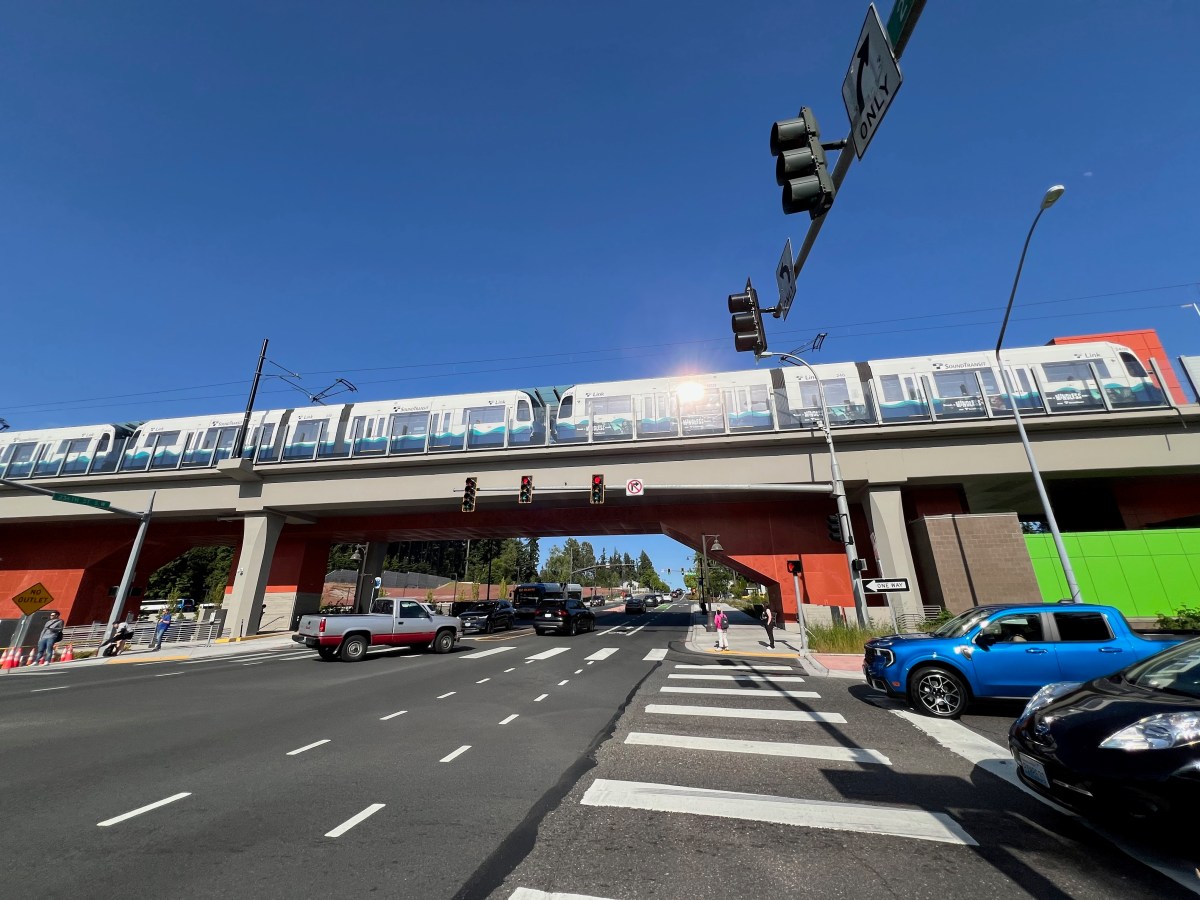
Mountlake Terrace, Pizza, and Art

I reached Mountlake Terrace yesterday. It was after a short ride down the Interuban Trail from Lynnwood Transit Center. Upon arriving, and more on the route in a moment cuz it’s worth its own write up, I made a right turn away from the Link station. My intent to roll downhill to the Zeeks Pizza and grab dinner.

As I rolled downhill the utter chaos of dystopian incompetence in parking was on full display. Full suburban entitlement was evident. Car after car, among the majority parked correctly, was pulled into the PBL (Protected Bike Lane). Some were parked halfway in the road, blocking the road and bike lane, all while beside an actual parking spot. A New Yorker would be enraged at the absurdity of parking beside a empty spot filled by a ghost, maybe?! But all that nonsensical disrespectful motorist shit aside, it was a quick roll down from the station and up on to the sidewalk to park.

There was a solid staple rack right out front of the Zeeks, so I saddled right up to that. I then perused the other establishments on the street here. There’s a coffee shop that looks like it’d be legit, but closes at 3:00pm and it’s 5:30 now. There is also a beer brew joint of some sort. All of it looked like legit quality joints! Not entirely what I’d expect this far out into the suburbs, but after the ride (again more on that in a moment), this Mountlake area is one of the more quality areas in the overall metro area! It’s really nice out here!

Anyway, I strolled my happy ass into the pizza joint. One of the staff (or proprietor, I don’t know) she offered I sit anywhere. I went ahead and took a seat on a two top. She came over, and provided menus and offered some beer options upon my curiosity. We discussed beer for a minute, Pfriem specifically because holy hell are they amazing, and then delved into our children and their recent chaos! No idea how we got there but it was a great multi-minute conversation. As the waitress came up and popped around the corner, the trio of us relayed by beer option and then the waitress and I discussed the varietal of pizza options I had before me.

Zeeks

I will admit, she struck me a bit off kilter because she had enthralling dermal facial and septum piercings of a uniqueness – a very artistic uniqueness – I’d not seen. With necklace, jewelry, and other accoutrement, she had an air about her that was very bespoke. Humans in Seattle are not cookie-cutter. Standing out as unique is rare and a significant compliment for me to ponder, let alone verbally offer someone.

I ordered my pizza and chatted with the team there a bit more. I had a pilsner – ok two because the Italian Pilsner was tops. Then I wrapped up. When I paid, I verbally complimented the waitress on her artisanal bespoke style. She genuinely appreciated my word soup compliment. We discussed the idea of one’s self being presented as a human art. In all seriousness, it’s a topic unto itself, but for those that know y’all know. Hat tipped to you all!

I then left. I had a good phone chat with my kiddo. After that, I mounted my steed to claim and uphill to the Mountlake Terrace Link Station. However I did deviate again and cut right. With a slight bit more hill climb, I rolled past. I gave a good look to the claimed “center” of Mountlake Terrace. I also eyed Hemlock State Brewing. Another trip will include that brewery!

With that I made a u-turn mid-suburb and got another hill drop down to the station. Rode the elevator up and the next Link rolled in within minutes. Boarded, and off I went wrapping up this very blog entry. Until next time, enjoy your transit trips, bike rides, and adventures! Slava Ukraini, may fascism fall on its face, and may your quality of life improve endlessly!

Where do Jane Jacobs and Wendell Cox Intersect?

I have been pondering lately, there is an intersection at life itself, but where do these two thinkers actually have intersections of thought?

Any ideas? Thoughts? Throw in some comments on anything that pops into your mind and we’ll get a conversation going.

Context: Follow the links for context on who Wendell Cox is and who Jane Jacobs are.

Portland’s PMLR Project, Where I’m Moving (One of These Days)…

First point of context. The PMLR stands for the Portland-Milawukie Light Rail Project. The name is somewhat misleading, because it is dramatically more than merely a simple little light rail project. I’ll add more context to what exactly it is over the blog entries following this one. For now, I want to detail a particular chunk of the area where the PMLR is being built that I’ve decided I’d like to live one day.

As I’ve been traveling back and forth between southeast and downtown Portland I’ve made many trips through the inner southeast industrial area near OMSI. The Tilikum Bridge is going in just south of OMSI and a number of streetcar, light rail, road, bicycle and pedestrian amenities are being added to the area. It’s rather exciting for a future prospective resident of the area surrounding the line.

The Tilikum Bridge looking west almost a year ago.

The Tilikum Bridge looking west almost a year ago.

Currently I’m still pretty much a downtown urbanite Portlander and also have spent a few years living on the inner east side near Clinton (closer to Division for a year and closer to Powell for another year). But with the addition of the PMLR I intend to buy a house and move somewhere near the first 2-3 stops of the line on the east side of the river. At least ideally. Basically, somewhere in this area:

A simple map of the area around the PMLR where I'm intending to buy a home.

A simple map of the area around the PMLR where I’m intending to buy a home.

Here’s a map from Google Maps that shows more detail specifically where I’m looking and where some sweet spots will be in relation to the PMLR. There’s a bunch of others, but these are my picks so far.

The prospective areas I'd like to move to, rated by priority choice (at least at this time, maybe that'll change)

The prospective areas I’d like to move to, rated by priority choice (at least at this time, maybe that’ll change)

The areas that have ? marks in them have planned development, mostly towers or higher density housing stock. This could be cool, but also could be super lame, I’ve no idea nor is anything certain in that area. I’d also like to not look directly at an interstate or major highway of any sort. The further from a primary arterial and the closer I can be to people and places that depend on bicycles, transit or walking the better.

Over the next few weeks I’m going to add a lot more information about the PMLR and why it’s acting as a major impetus to actually move to the area and buy (of course, depending on a number of other things that take place in the next few years in this nation and based on the actions that this date kicked off).

Anyway, enjoy, the countdown has begun. Trimet even posted a massive countdown clock!

PMLR Countdown Site (Officially 358 days from opening!)

PMLR Countdown Site (Officially 358 days from opening!)

Portland Meeting w/ The City on Street Deaths, Maintenance and What To Do

Thursday night at 6:30 kicked off a public meeting at the Sunnyside Environmental School. This topic concerns everybody from the motorist who wants better roads and roads to last to the cyclist who wants to be able to ride peacefully down a greenway into work to the pedestrians who would like to walk down the street with their children and not fear that one of them may be killed or maimed by an errant driver. Ok, so a few stats to start this article off. The first are few from this image and derived information (ie, I did some simple math after speaking with one of the street engineers on hand and also others that work for the city, they know this material very well).

Portland General Fund (Click for full size image)

Portland General Fund (Click for full size image)

First thing to note, because it escaped me for about 2 seconds until my friend Tony pointed it out, public safety actually translates to police and fire. So let’s just put that out of our minds as anything that we’re allowed to be “flexible” with. But the real kicker, is we get down to actual road budgets in the general fund. The transportation and parking budget is a mighty whopping 2% at $8.7 million dollars. When it comes to road maintenance and other such things, that isn’t a lot to work with. Now keep in mind there is still the gas tax, which in Portland isn’t a huge amount of money but it adds a few million more. But a lot of that goes to other roads too. ODOT takes a cut, the Feds of course take a cut of gas taxes, etc. The gas tax however is NOT a large amount of money and does NOT fill the gap between needed roadway work and related things. The simple fact is, gas tax plus general budget funds don’t really cover but about 20-30% of our roadways. More on that in a moment. The second image I took is of a little budget pie chart split out.

Pavement System (Click for full size image)

Pavement System (Click for full size image)

Up in the left hand corner (click if you can’t see it in the regular sized image) of the image you’ll see a few stats.

  • 4,827 lane miles in Portland’s road system. (that’s 1 lane that is 1 mile long, it does not include ODOT roads like 82nd, Powell and others, nor does it included Interstates (federal/state/ODOT) or related roads that happen to come into Portland)
  • 1,871 of busy streets. These are basically arterials where there are buses, trucking, etc. These are the arterials, sometimes including neighborhood arterials like Division, Hawthorne and other such extremely busy streets.
  • 2,971 lane miles of neighborhood streets.
  • $5~ about 5 billion in value.
  • 52% of busy streets are in fair or better condition.
  • 46% of neighborhood streets are in fair or better condition.

Simple Math, We’ll Have to Give Up Some Roads Soon

As I spoke with one of the city engineers about this information I asked, “based on the budget or even doubling the budget, how many lane miles can the city of Portland maintain?” He did some quick math in his head. I then confirmed that number based on some extremely conservative estimates the city could maintain about 1300-1500 miles of roads. As shown above on the chart, there are 4,827 lane miles in Portland, which leaves somewhere between 3,327-3,527 that can’t be maintained. Looking at things another way, Portland has enough money to cover most of the maintenance of the busy streets in the city but not the neighborhood streets. The city has 3,327 to 3,527 miles of streets that will continue to fall into disrepair.

But what about the unpaved streets? They measure approximately 60 miles of unpaved streets in the city. Most cities have somewhere around the same to dramatically more unpaved streets than Portland. Many of the streets are short blocks that lead immediately into a paved street, alleviating much connectivity issue. All of the unpaved streets are used rarely by anybody but the people that live on the street or a few others that might pass by. Emphasis on a “few”. So the question really is, “so what about em’?” With that I’m going to drop this point for a few, because while a few people fuss about 60 miles of unpaved streets there are 3,327-3,527 miles that are merely years away from becoming unpaved. Priorities here people, priorities.

So there seems to be some options here that are going to take place no matter what we do. No significant money is going to become available. The feds aren’t exactly swooping in to save the disappearing gas tax revenue. It’s up to the cities, and the only options on the table for streets are to let some of them disappear from the cities list of streets to maintain. In New Orleans I recall seeing those notorious signs “This Street No Longer Maintained”. That sign meant the city of New Orleans was done with that street, it was up to the local community to do anything with it. Most people on the street and surrounding areas were actually fine with that. They didn’t care.

What to do with all these streets we can’t maintain? As road budgets get strained even further there is going to be increasing pressure to abandon the notion that a street must be provided to every single doorstep in America. It just isn’t possible, never was, and never will be.

So the question is, with well over 3,327 miles of of road miles about to be left untouched, why keep wasting them as mere roadways. What should we do with them? Some neighborhoods have even reclaimed low yield streets and planted mid-road gardens, turned them into neighborhood parks and other such wonderful additions. Why not officially start declaring some streets as off the books and let the neighborhoods really, truly take back their streets!

There’s a lot of potential in this issues to reclaim the streets and make our neighborhoods more livable, safer for our families, friends and children and make our city more efficient in the process. What are your ideas for these 3,327 miles of roadway?

NOTE: The Oregonlive also published a wrap up with some good quotes from attendees @ http://www.oregonlive.com/portland/index.ssf/2014/02/city_asks_residents_where_do_w.html

Portland Milwaukie Light Rail Bus Planning

In the coming months Trimet is going to be putting together a bus plan for the redundant service along the new corridor. The simple reasoning is that buses cost more to operate over time than light rail, a lot more, and the ideal situation is to get as many people to take the light rail and operate feeder service to get people to the light rail. This is a tricky process, here’s a few of the reasons why:

  • Some bus lines would be more logical, like the #33, the stop in Milwaukie or the last stop of the PMLR line and transfer all passengers to a waiting MAX train. The MAX won’t have traffic to battle, will have an easier and faster ingress trip and egress trip out of the city. Timing the connection with the #33 will be really easy, as the service can now operate as an extension of the light rail service instead of fighting with traffic on McLoughlin (the bulk of its trip between Portland and Milwaukie). So a large part of the #33 route could be canceled, saving millions per decade and putting that money into other bus operations and capital such as the #33 between Oregon City and Milwaukie.
  • Other bus lines get tricky, the #19 for instance will cross over (with its current route) the new MAX at one of the stations. But the route on either side of that serves people that may or may not be going downtown. Beyond that, making connections with the MAX is more difficult because of its less than frequent service and which direction would connect with which MAX? The #19 wouldn’t just be merely an extension, but instead would act largely like a feeder. An example would be, if someone got on in the suburbs, instead of riding the whole route it would be faster to deboard and alight the coming MAX train, that would arrive in town faster and more reliably than the #19 bus would. This route then becomes a question of, “what to do?” Increase service? Leave it untouched? Decrease service between X & Y points, increase service immediately between MAX connection points to enable better connector service?
  • #31 and #32 both come from various parts of the metro area and converge on McLoughlin, again making for a perfect direct connection with the MAX. However both buses are arguably faster during low traffic times and slower during higher traffic times. Both bus routes are generally low ridership, so connecting the transfers to the MAX might behoove costs, but maybe not ridership. It however could have the opposite affect on ridership and increase. Would having the end points connected between Clackamas Town Center (where one of the buses goes) vs. where the other goes be improved if we bumped up service levels and connected it reliably to the MAX line going in? What would be the loss vs. the gain of doing so? Whatever the case, it isn’t smart continuing to run these two routes as is when the MAX line offers a lower cost option than running the bus just for the few riders that do take it along the McLoughlin Corridor – in this case, one would logically try the increased connector service but eliminate the service along McLoughlin into downtown. This would create a two-seat (ie. a transfer is required) ride to downtown but it would make for a dramatically more cost efficient ride if the ridership stays relatively the same on these routes or slightly increases. If it increases dramatically it would still be best to transfer riders to the MAX instead, as more service could be provided overall.

Have you thought much about how the service will change, what might change, or thought about getting involved? If any of these buses are ones you ride you should check out the upcoming bus service planning around the opening of the PMLR line. You can’t wait and expect to make a difference, you have to get involved now! Here’s a list of the lines that will be affected with the opening of the PMLR in 2015 (and possibly sooner even).

  • 9-Powell Blvd
  • 17-Holgate/Broadway
  • 19-Woodstock/Glisan
  • 28-Linwood
  • 29-Lake/Webster Rd
  • 30-Estacada
  • 31-King Rd
  • 32-Oatfield
  • 33-McLoughlin
  • 34-River Rd
  • 35-Macadam/Greeley
  • 36-South Shore
  • 43-Taylors Ferry Rd
  • 66-Marquam Hill/Hollywood
  • 70-12th/NE 33rd Ave
  • 75-Cesar Chavez/Lombard
  • 99-McLoughlin Express
  • 152-Milwaukie