Talking Bakfiets

Recently I was out running errands on my R & M Load 75. I’d stopped by my storage unit to drop off a few crates of things that didn’t need to be sitting around my garage. Then I’d headed over to Village Square Cafe for a diner like breakfast.

Then went about seeing if I could find a plugin somewhere to charge my bike, as my charge was low. I had my spare battery set just for good measure, but I was down to ~35% because I’d forgotten to charge the bike earlier the previous night. So I didn’t technically need a charge but I figured it would be nice to charge up if I could. Albeit, something I’m astutely aware of now, is that there are next to zero publicly accessible outlets in Redmond. Not really surprising, electricity isn’t cheap, but I was sure I’d seen a few I could *borrow* a charge from. 😬

In the end, that would be kind of stealing, but places also let you easily charge your laptop, albeit that’s negligible vs. two monster bike batteries. Still not charging an excessive multi-ton car, but substantially more than I presume most places to want to offer for free.

Anyway, I didn’t find one but I did go rolling into the Town Center and met Nina (Spelling?) as she walked right up to me and inquired about the R&M Load 75. After discussing for a few minutes I hope to see her riding about on a new Load 75 in the near future with her kiddo! It’d be great to have more company over here on the east side in the bakfiets community!

On that note, I’m going to finally get around to setting up a bakfiets meet here on the east side, stay tuned over @ https://bakfiets.bike/ to get that notification (i.e. subscribe for email and you’ll get notified in your inbox). So far this year has started off a bit nuts and with the closure of G&O a few months ago it really threw me off for starting the bakfiets meets!

Eastside Link Light Rail

One of the places I’ve started frequenting to work in, as it’s nice and large, plenty of seats, is the Dote at Redmond Technology Station. Two issues, which is kind of standard for Microsoft, is that they get places like this on campus but then don’t really truly open them up to the public. They don’t offer a public wifi but sometimes have the public Microsoft account that you can use. But that’s a bit sketch, to which hopefully Microsoft sorts that out with the private businesses that they invite onto campus to operate but then make them operate as pseudo private establishments. A coffee shop in this modern era has wifi, so come on Microsoft, let em’ have truly public usable wifi!

But I digress, wifi aside, it’s a really interesting location. Super chill to work there, however I am concerned it stays open over time considering the current state of light rail opening (it’s partially open).

The starter line, as it has been dubbed, runs from Redmond Technology Station to Bellevue South. The key population center it runs through is Bellevue, which provides some anchor to a degree, albeit very few people seem ready to use it in Bellevue and as many in the area know, Bellevue is about as auto-dependent and pedestrian friendly as a parking lot. There are parts of it that are nice but overall it isn’t really acclimate to walking or to using transit, sadly enough. It’ll get there one day, considering the transit center and routes, but overall the people here are a bit myopic about the whole situation – so far.

That’s it for today’s thoughts, back into introspection.

Boarding Behavior, Bonkers, and How-to for Transit Usage in Cascadia

I was riding the Yellow Line as it changed to an Orange Line one morning. It reminded me of something. One of the thigns in Portland, and largely the Cascadia region peoples, among transit systems is the poor boarding behavior of bus and light rail riders. Here’s a quick sitrep of the dumb stuff we Portanders, Seattleits, Vancouverites, Vantuckians (Vancouver USA).

Boarding

The first problem is boarding. We Cascadians seem to forget, almost entirely, that mass needs to be displaced from a space before other mass can take that space. So what do we do that shows are complete obliviousness to this reality? We all clump around the entrances of the bus or the light rail vehicles as they arrive for boarding and deboarding. It doesn’t matter if there is one door, four or six doors.

The way this happens is people walk up and surround the door. You might ask, “Why is this a problem, they have to board?” Well yeah, they do need to board, but first people should exit – or displace themselves from the vehicle – before more people board that vehicle. It’s simple physics people, and we often fail miserably. Don’t block people from exiting, we are good at it, but stop doing this dear Cascadians. In the end, it’ll help us all.

Ride Clumping

The next thing that the Cascadian people do is board and them clump by the door they board. I don’t understand this effect, except I do, but I don’t understand why we humans can’t resolve it more easily or resolve it through experience. Most of us Cascadians riding transit are experienced riders. We know how the system or systems work but we still clump near the doors. We often just stand instead of sitting, then we look around confused and dazed while we’re all stuck near the doors shoulder to shoulder while the mid-section of the bus or the light rail vehicles have plenty of space. Even worse, we’re all clumped while there are available seats to sit in.

So let me lay this one out bluntly. Here’s what you do when you board a transit vehicle.

  1. Shutup and sit the down. This should be the easiest thing ever, but just work on it, because obviously it is hard for some reason.
  2. If you can’t sit down, then move away from the doors and stand there. Also shutup.
  3. If people are clumped, move through them to the open area and stand (or sit if they’ve neglected the seats). Then shutup.

If we Cascadians can pull this off we will all do dramatically better when riding transit. We’ll have more space, easier flows and easier movement on and off vehicles. If we get good enough we might even have faster service! Shockers!!!

Cheers,
Transit Sleuth

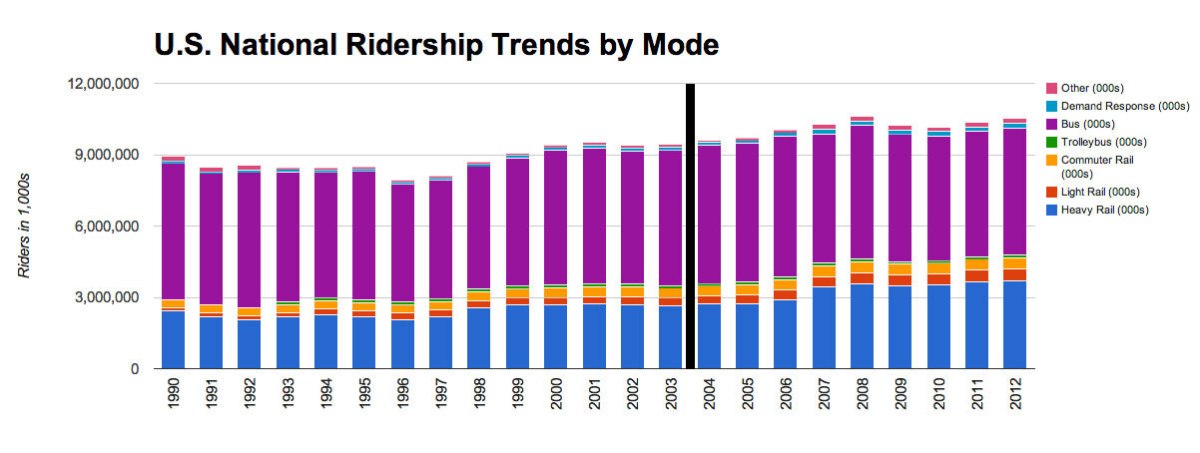
National Transit Ridership

Cycling at 6% of Commute, Transit at 8% and … Blagh, Blagh, Blagh…

Let’s talk numbers and the real world. I’m going to lay out a few things in this post.

  1. Why the way we measure auto versus cycling versus transit versus walking commutes in metropolitan areas is an absurd, myopic and broken way to set policy around roads and systems in which modes are used on those roadways.
  2. Why the 6% bicycle commuting number is barely the tip of the iceberg of cycling in Portland.
  3. Why measuring commutes for the entire metropolitan area is counter productive for the city of Portland the surrounding cities of Hillsboro, Gresham, Beaverton, Tigard, Milwaukie, and other places in the metro area.

#1 – Measuring The Commute for the Metropolitan Area

The way urban planners, traffic engineers, and others measure the daily commute is usually by modal splits. What that means is each mode is assigned the percentage of the trips taken with that particular mode.

Let me detail the current way this is measured with an example. There are 2,314,554 persons in the metropolitan area of Portland. At the current labor force participation rates in the Portland metropolitan area we can safely assume that about 50% of these persons would be commuting to work. That gives us about 1,157,277 persons traveling to a place of employment and back every day.

Based on the 1,157,277 daily commutes in the metropolitan are of Portland, at 6.1% the area has about 69,436 people cycling to work everyday. Just think about that for a minute, that’s a sizable number of people bicycling. But is this an honest measurement of Portland commuting as a city? Does the metropolitan area really represent the city? Does that 69k+ people represent cyclists in Portland?

A quick side note…

For the actual city or Portland the population is 609,456 with the commuters coming to about 304,728. Here’s a map of the actual city of Portland, note the red outline around the city.

The City Limits of Portland

The City Limits of Portland

I won’t write about these numbers just yet, but I’ll bring them back up further along in this blog entry.

Is Gresham Portland? Is Hillsboro Portland? Is Salem Portland?

Let’s dive in on what exactly the metropolitan area actually is, then we can look at how ridiculous this measurement really is. Here’s a map of the metropolitan area of Portland.

The Metropolitan are of Portland

The Metropolitan are of Portland

Do you see how big that red area is? That is the metropolitan area of Portland. Does this strike you as a bit odd? Based on what is included in that area, the 6% measurement is absolutely amazing. It’s super impressive when the area is, by a huge order, completely suburban and rural areas that happen to all fit inside of this giant metropolitan area. Wikipedia even has a completely stand alone page dedicated to Portland’s metropolitan area (as it does many other metropolitan areas). This is the normal area that many statistics are derived for policy and decision making at federal, state, county (parish), city and even at the neighborhood level sometimes.

The metropolitan area of Portland includes;

  • Vancouver, Washington @ 161,791 people
  • Gresham, Oregon @ 105,594 people
  • Hillsboro, Oregon @ 91,611 people
  • Beaverton, Oregon @ 89,803 people
  • …and many others.

The 6% number is completely irrelevant, as are any modal splits, based on the metropolitan statistics for each of these cities. Including the city of Portland itself at 609,451 people. So why do we measure at the metropolitan level and then attempt to make quotes and other speculations or even decisions for our city this way? It’s a very valid question considering how often many of the cities surrounding Portland and Portland itself make decisions based on these metropolitan measurements.

There is some use of these statistics that are valid, but time and again they’re brought up to say “the majority of people drive” and “nobody rides bikes” and “barely anybody walks” when that might be true for some auto-dependent neighborhood in Vancouver, Washington but it is absolutely not true for the actual city of Portland. So why hold Portland to the condemnation of the metropolitan area’s statistics? It comes up all the time, people making pro- or anti-biking arguments based on the 6% number. Sometimes people even compare the 6% metropolitan number to the plan to get 25% mode share in Portland (the city) by 2030. Who’s kidding who, we aren’t getting anything positive out of the suburbs in this regard, they’re going to still be polluting the inner city with their commutes and killing each other with their cars by the time Portland gets to 25% mode split.

One last reason to toss this whole metropolitan area focus, especially for the 6% cycling mode split, or the 81% automobile mode split, or whatever number you’re comparing. Let’s get down to the business of the actual communities. Portland is not Gresham, Gresham is not Vancouver, and the others’ are not this or that part of the city. They each have different metrics. But the city of Portland itself has a bicycling mode split for transit that is huge and one for cycling that is also much higher than the metropolitan area. The city of Portland also has a minority use of single occupancy vehicle trips. This might be painful, but give this report and good review. Yup, that’s 43.9% auto use for trips in the CBD. CBD stands for central business district. That’s down from 58.4% in 1994, a pretty damn good improvement. In the CBD transit usage is at 44.5% of trips, up from 33.6% in 1994. These are the types of numbers we actually need to look at to determine goals, not the misleading data of the metropolitan numbers.

#2 – Tip of the Iceberg of Bicycle Usage

I’ve talked about the absurdity of following metropolitan numbers in determining policy in Portland, now I’m going to take a stab at this 6% nonsense. The 6% number is great for the metropolitan area, like I was saying, that’s an impressive achievement when you factor in all of the blatantly hostile areas where some of the riders come from. As anyone who rides regularly knows, a bike lane right beside 30mph+ traffic is tantamount to insanity. There is zero comfort when you know one cell phone talking motorists swerves a little and your life is over. The vast majority of our roads and ways to get into and out of the city of Portland area are still these types of roads. There are very few dedicated paths or cycle-tracks that would encourage the mythic 60% “interested” population to jump on a bike and ride into town. Albeit among all of this frustration with the current 6% number being stagnant for several years now, there are a few trends that lead me to believe that this 6% isn’t all it’s cracked up to be. Here’s my list of why the 6% number is illegitimate at this point:

  1. The first reason, goes back to the first thing I wrote about in this blog article – metropolitan numbers aren’t representative of the area we’re trying to measure, which notable is the city of Portland, not the metropolitan area. So let’s measure Portland, not Gresham and Hillsboro and the other areas. PBOT and the city have almost zero net impact on how those cities determine and act to improve cycling, so we really should focus more specifically on Portland’s numbers instead of the averaged number across the entire metropolitan area.
  2. Who’s ridden across any of the bridges that have cycling measurements lately? Notice how on Hawthorne this year (2014) the same drop off didn’t occur in cycling commuters during the winter time as in previous years (2013, 2012, 2011, etc)? It looks like, and I’m waiting to get hold of the actual data, that the drop off was only about 10-30% off of the peak summertime commuters instead of the traditional 40-60% drop off! That’s huge. If that is being maintained, it would appear that somehow there are more consistent riders – which wouldn’t show an actual increase, but it would also lead to a ground swell of advocates that are really holding to it. But that leads me to the next observation…
  3. Who rides around on the east side on weekends or during the week? Ever noticed how there are steadily more and more cyclists going about their business on the east side during the day? I did a couple of measurements: 34th and Clinton, 35th and Hawthorne, 35th and Belmont and Going at the 15th Street Diverters. At each of those locations I saw a steady increase in ridership over the year that I was riding across these areas during the day to do business. I’d stop and count for 15 minutes at a set time each day. After the year and numerous measurements I saw an increase of about 15-20% at each intersection. Even though the results weren’t done in a rigorous way, I did follow a scientific approach. Even without the rigor, and doing this out of pure curiosity, I can’t really ignore them since they were consistent over time.

The simple observation is this. Something is happening within the biking movement in Portland, and it isn’t a decreasing bike share of commuters. There is instead a ground swell of advocacy, an increasing frustration with the speed infrastructure is being built and the kind, and there is a growing love of biking among many in the city. They may not be bike commuters yet, but there is a huge percentage of people out there biking in other ways, and the simple fact is we aren’t measuring them, even though they should indeed count!

#3 – Why measuring commutes is … not a good measurement!

I’ll dive straight into these reasons.

  1. Commuting makes up a trip to work and a trip from work. That’s it, two trips. The average household makes 9 trips per day (see references below, there’s tons of data on this). Why is the measurement we use that dictates the vast majority of transportation policy dictated off of trips that only make up 2 our of 9 trips a day for a household? Fortunately in many cities, the cities take it upon themselves to determine what these other trips are and focus on these trips instead of commutes. However much of US policy at a federal, state, and even many cities, is entirely focused on commutes first.
  2. Commutes leave out everybody that’s not in the workforce, which in the Portland metro is hundreds of thousands of people, and even in the city limits of Portland itself is over a hundred thousand people. That means transportation policy dictated by “commuting data” leaves out an absolutely massive percentage of people. Are you a stay at home mom? Generally not included. How about a student in school? Yup, you’re not really included either. How about a retired person or someone looking for a job? Nope, you’re out too. That’s just absurd.
  3.  The ideal commute is not having a commute. We as a society often encourage remote worker situations, which completely removes someone from commuting. However a remote worker still makes the average number of trips based on household data. This means we’re pushing for people to work from home, remove themselves from the commute, but ideally we’d shift away from the daily commute dogma altogether! So why do we use it as the core policy planning and decision making metric? If anything we should take hold of the data from the OTHER trips and work with that data, the 7 instead of the 2. One might say it’s because everybody commutes and it is the easiest and most problematic event of the day – being it causes rush hour. But really, think about that for a minute and why do we still encourage rush hour with such zeal and gusto? If there’s a problem with the game, maybe we need to change the game!

Summary

Data is a fickle thing. There’s a reason the saying, “lies, damned lies, and statistics” exist. Numbers and data can be used to derive solid, intelligent, and wisely built solutions to problems. But they can also be used to do the exact opposite. When we discuss things we need to form real stories and cast out the absurd misinformation that is spread around by using single metrics. Stories need told with multiple measures identifying the full point of view of individuals in society. A single metric never produces an intelligent and well structured system of solutions, it just leaves us behind.

I’d like to see us move forward more in the United States. Understanding the systemic nature of measurements (the Research Center OHAS 2011 summary is a good starting point) and how they interact and work together will help us actually do that. Cheers, and happy number hunting!

References

Where do Jane Jacobs and Wendell Cox Intersect?

I have been pondering lately, there is an intersection at life itself, but where do these two thinkers actually have intersections of thought?

Any ideas? Thoughts? Throw in some comments on anything that pops into your mind and we’ll get a conversation going.

Context: Follow the links for context on who Wendell Cox is and who Jane Jacobs are.

What Infrastructure Would you Want To See in Oregon and Portland?

I’ve been pondering what ideal wins the infrastructure czars (you know, the Governor of the state, mayor of Portland, Bend, Eugene, Salem and all the other leaders of Oregon) could and should push for these days. With the recent and still ongoing absurdity of the I-5 Bridge to the epic nature of the new bridge in Portland that is Bike, Ped, Bus, Light Rail and Streetcar only bridge, it begs the question. What infrastructure would be awesome to have added to Oregon, and specifically Portland, Eugene, Salem and other such cities and towns? What is reasonable and what would actually be a good return on the effort and investment for the state? What is a good investment to direct a good and effective future path for the state? That’s just the beginning of the questions though, one could write a thick book of endless questions.

But with that in mind, here’s a few I’ve been thinking of just recently.

  1. Rail service enhancement into Vancouver from Portland. Rail service that could be used for, but doesn’t necessarily mean passenger service initially. The bottleneck on either side of the Columbia River is a problem space, however with some solid double tracking, or even triple tracking from Portland north through Vancouver to the Battle Ground area and even out toward Camas we could get some serious benefit from this. Freight could be handled by rail into the city and out of the city more easily, putting intermodal points at locations that better serve Portland and Vancouver instead of so many trucks driving into and out of the cities via interstate. The other notion would be, at some point, with appropriate access real commuter rail service could be offered easily from points north like Battle Ground, Camas, and other locations and have them funnel through Vancouver’s station and into Portland. We’re talking about 15-30 minute commutes. Light rail will never accomplish this, bus service won’t accomplish this, only passenger rail could accomplish this. As the current service, albeit not effective as commuter rail, already serves the corridor from Vancouver to Portland in about13-16 minutes, pending they get a slow order or not. Regardless, for bang for the buck, subsidizing a rail infrastructure expansion here would go far beyond any other motorized infrastructure investment in the area.
  2. Cycle track system, not just a few cycle tracks. Not faux bike infrastructure but real bike infrastructure. Let’s put 20-30 million into it every year for the next decade, then let’s see where we get an truly reevaluate that. For the $200-300 million it would cost to get Portland true bicycle infrastructure on a world class scale similar to Amsterdam, it would easily give us the ability to hit the 25% mark for cycling. This in road bike infrastructure however is a joke to most people, and seriously, it still just exacerbates the more neanderthal drivers to freak out the less assertive cyclists. Very frustrating to see such an opportunity go down the drain. As for that investment, we already know the more cycle oriented parts of town are doing crazy good business, have healthier, happier and more effective citizens then the auto oriented areas – so seriously, we need to get our ass in gear in this regard.
  3. BRT – Bus Rapid Transit needs to be put into play in a number of areas from Eugene to Salem to Portland. BRT would be highly effective in acting as core arterials feeding the existing light rail systems, and as systems feeding directly into the city cores. BRT should be implemented as true BRT, not the faux junk implemented in Seattle, but as dedicated – possible to upgrade to LRT or even heavy rail in the future – with regular 5-7 minute service for more than 10 hours a day. Ideal points to connect in Portland would be Gresham down Powell to downtown Portland, 39th street north and south as a feeder from St Johns out and down to Hollywood and into Milwaukee, and another possible great route would be to setup a core run somehow on Barbur and put some traffic calming into place so motorists stop killing pedestrians and other motorists on that arterial. BRT could play a huge part in future build outs, especially since we need to bulk up ridership with frequency more than “luxury light rail”. Light rail is still needed, but with the completion of the Portland-Milwaukee Light Rail, we’re good for the next 10-20 years for rail infrastructure as our corridor backbone. Let’s get to feeding it as we should to make it easier and faster to use.
  4. My last thought is actually a huge way to spend a little money and over time save millions upon millions. There are untold miles of roads in Portland that we can’t afford to maintain, along with roads in Salem, Eugene and every major city and even more road miles in rural parts of the state. We should designate some of these roads as either toll roads, no longer maintained roads (i.e. close them unless a private entity wants to take responsibility for them) and especially in the city let’s figure out which roads we can cut out, stop maintaining, turn into parks, do turn outs or cut offs to improve neighborhoods and decrease costs or one of another zillion options. Simply, we have too much road infrastructure for a limited budget at the national, state and city and county levels. Let’s scale back appropriately. If motorists want to pay more to have more infrastructure, let’s actually foot the bill instead of continually pawning it off to bonds of various sorts that often end up in foreign hands. Our current road funding models are just insane, let’s budget what we can afford instead of living so far past our means. This would economically, environmentally and socially be logical as well as getting people to face the reality that we’re overbuilt on debt and poorly run infrastructure – we can do better.

That’s my top 4 that ought to have something done sooner than later. I’d love to see what your top choices would be. Leave a comment or three with your thoughts, I’ll put them into a larger write up that might even be put forth to implement. Cheers and happy riding!