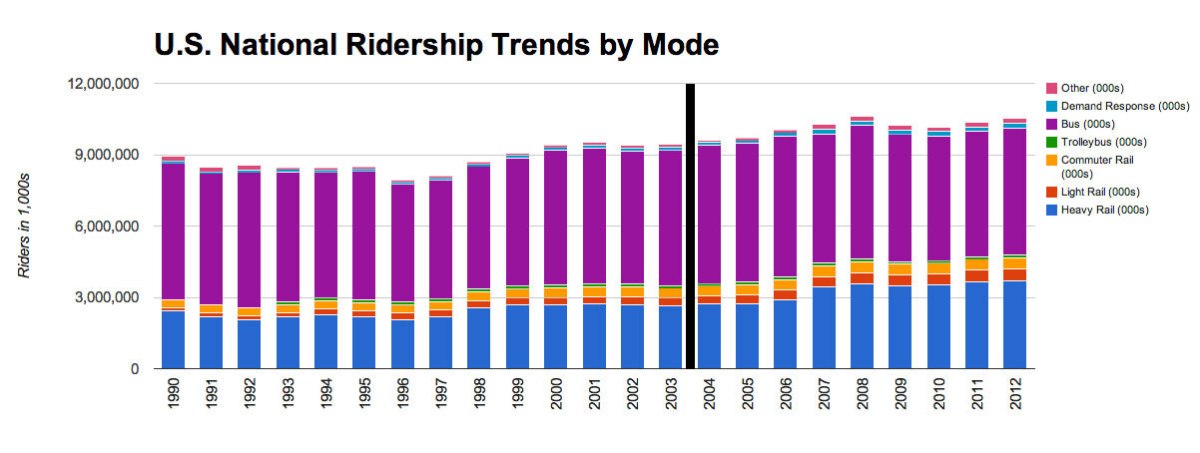
National Transit Ridership

Cycling at 6% of Commute, Transit at 8% and … Blagh, Blagh, Blagh…

Let’s talk numbers and the real world. I’m going to lay out a few things in this post.

  1. Why the way we measure auto versus cycling versus transit versus walking commutes in metropolitan areas is an absurd, myopic and broken way to set policy around roads and systems in which modes are used on those roadways.
  2. Why the 6% bicycle commuting number is barely the tip of the iceberg of cycling in Portland.
  3. Why measuring commutes for the entire metropolitan area is counter productive for the city of Portland the surrounding cities of Hillsboro, Gresham, Beaverton, Tigard, Milwaukie, and other places in the metro area.

#1 – Measuring The Commute for the Metropolitan Area

The way urban planners, traffic engineers, and others measure the daily commute is usually by modal splits. What that means is each mode is assigned the percentage of the trips taken with that particular mode.

Let me detail the current way this is measured with an example. There are 2,314,554 persons in the metropolitan area of Portland. At the current labor force participation rates in the Portland metropolitan area we can safely assume that about 50% of these persons would be commuting to work. That gives us about 1,157,277 persons traveling to a place of employment and back every day.

Based on the 1,157,277 daily commutes in the metropolitan are of Portland, at 6.1% the area has about 69,436 people cycling to work everyday. Just think about that for a minute, that’s a sizable number of people bicycling. But is this an honest measurement of Portland commuting as a city? Does the metropolitan area really represent the city? Does that 69k+ people represent cyclists in Portland?

A quick side note…

For the actual city or Portland the population is 609,456 with the commuters coming to about 304,728. Here’s a map of the actual city of Portland, note the red outline around the city.

The City Limits of Portland

The City Limits of Portland

I won’t write about these numbers just yet, but I’ll bring them back up further along in this blog entry.

Is Gresham Portland? Is Hillsboro Portland? Is Salem Portland?

Let’s dive in on what exactly the metropolitan area actually is, then we can look at how ridiculous this measurement really is. Here’s a map of the metropolitan area of Portland.

The Metropolitan are of Portland

The Metropolitan are of Portland

Do you see how big that red area is? That is the metropolitan area of Portland. Does this strike you as a bit odd? Based on what is included in that area, the 6% measurement is absolutely amazing. It’s super impressive when the area is, by a huge order, completely suburban and rural areas that happen to all fit inside of this giant metropolitan area. Wikipedia even has a completely stand alone page dedicated to Portland’s metropolitan area (as it does many other metropolitan areas). This is the normal area that many statistics are derived for policy and decision making at federal, state, county (parish), city and even at the neighborhood level sometimes.

The metropolitan area of Portland includes;

  • Vancouver, Washington @ 161,791 people
  • Gresham, Oregon @ 105,594 people
  • Hillsboro, Oregon @ 91,611 people
  • Beaverton, Oregon @ 89,803 people
  • …and many others.

The 6% number is completely irrelevant, as are any modal splits, based on the metropolitan statistics for each of these cities. Including the city of Portland itself at 609,451 people. So why do we measure at the metropolitan level and then attempt to make quotes and other speculations or even decisions for our city this way? It’s a very valid question considering how often many of the cities surrounding Portland and Portland itself make decisions based on these metropolitan measurements.

There is some use of these statistics that are valid, but time and again they’re brought up to say “the majority of people drive” and “nobody rides bikes” and “barely anybody walks” when that might be true for some auto-dependent neighborhood in Vancouver, Washington but it is absolutely not true for the actual city of Portland. So why hold Portland to the condemnation of the metropolitan area’s statistics? It comes up all the time, people making pro- or anti-biking arguments based on the 6% number. Sometimes people even compare the 6% metropolitan number to the plan to get 25% mode share in Portland (the city) by 2030. Who’s kidding who, we aren’t getting anything positive out of the suburbs in this regard, they’re going to still be polluting the inner city with their commutes and killing each other with their cars by the time Portland gets to 25% mode split.

One last reason to toss this whole metropolitan area focus, especially for the 6% cycling mode split, or the 81% automobile mode split, or whatever number you’re comparing. Let’s get down to the business of the actual communities. Portland is not Gresham, Gresham is not Vancouver, and the others’ are not this or that part of the city. They each have different metrics. But the city of Portland itself has a bicycling mode split for transit that is huge and one for cycling that is also much higher than the metropolitan area. The city of Portland also has a minority use of single occupancy vehicle trips. This might be painful, but give this report and good review. Yup, that’s 43.9% auto use for trips in the CBD. CBD stands for central business district. That’s down from 58.4% in 1994, a pretty damn good improvement. In the CBD transit usage is at 44.5% of trips, up from 33.6% in 1994. These are the types of numbers we actually need to look at to determine goals, not the misleading data of the metropolitan numbers.

#2 – Tip of the Iceberg of Bicycle Usage

I’ve talked about the absurdity of following metropolitan numbers in determining policy in Portland, now I’m going to take a stab at this 6% nonsense. The 6% number is great for the metropolitan area, like I was saying, that’s an impressive achievement when you factor in all of the blatantly hostile areas where some of the riders come from. As anyone who rides regularly knows, a bike lane right beside 30mph+ traffic is tantamount to insanity. There is zero comfort when you know one cell phone talking motorists swerves a little and your life is over. The vast majority of our roads and ways to get into and out of the city of Portland area are still these types of roads. There are very few dedicated paths or cycle-tracks that would encourage the mythic 60% “interested” population to jump on a bike and ride into town. Albeit among all of this frustration with the current 6% number being stagnant for several years now, there are a few trends that lead me to believe that this 6% isn’t all it’s cracked up to be. Here’s my list of why the 6% number is illegitimate at this point:

  1. The first reason, goes back to the first thing I wrote about in this blog article – metropolitan numbers aren’t representative of the area we’re trying to measure, which notable is the city of Portland, not the metropolitan area. So let’s measure Portland, not Gresham and Hillsboro and the other areas. PBOT and the city have almost zero net impact on how those cities determine and act to improve cycling, so we really should focus more specifically on Portland’s numbers instead of the averaged number across the entire metropolitan area.
  2. Who’s ridden across any of the bridges that have cycling measurements lately? Notice how on Hawthorne this year (2014) the same drop off didn’t occur in cycling commuters during the winter time as in previous years (2013, 2012, 2011, etc)? It looks like, and I’m waiting to get hold of the actual data, that the drop off was only about 10-30% off of the peak summertime commuters instead of the traditional 40-60% drop off! That’s huge. If that is being maintained, it would appear that somehow there are more consistent riders – which wouldn’t show an actual increase, but it would also lead to a ground swell of advocates that are really holding to it. But that leads me to the next observation…
  3. Who rides around on the east side on weekends or during the week? Ever noticed how there are steadily more and more cyclists going about their business on the east side during the day? I did a couple of measurements: 34th and Clinton, 35th and Hawthorne, 35th and Belmont and Going at the 15th Street Diverters. At each of those locations I saw a steady increase in ridership over the year that I was riding across these areas during the day to do business. I’d stop and count for 15 minutes at a set time each day. After the year and numerous measurements I saw an increase of about 15-20% at each intersection. Even though the results weren’t done in a rigorous way, I did follow a scientific approach. Even without the rigor, and doing this out of pure curiosity, I can’t really ignore them since they were consistent over time.

The simple observation is this. Something is happening within the biking movement in Portland, and it isn’t a decreasing bike share of commuters. There is instead a ground swell of advocacy, an increasing frustration with the speed infrastructure is being built and the kind, and there is a growing love of biking among many in the city. They may not be bike commuters yet, but there is a huge percentage of people out there biking in other ways, and the simple fact is we aren’t measuring them, even though they should indeed count!

#3 – Why measuring commutes is … not a good measurement!

I’ll dive straight into these reasons.

  1. Commuting makes up a trip to work and a trip from work. That’s it, two trips. The average household makes 9 trips per day (see references below, there’s tons of data on this). Why is the measurement we use that dictates the vast majority of transportation policy dictated off of trips that only make up 2 our of 9 trips a day for a household? Fortunately in many cities, the cities take it upon themselves to determine what these other trips are and focus on these trips instead of commutes. However much of US policy at a federal, state, and even many cities, is entirely focused on commutes first.
  2. Commutes leave out everybody that’s not in the workforce, which in the Portland metro is hundreds of thousands of people, and even in the city limits of Portland itself is over a hundred thousand people. That means transportation policy dictated by “commuting data” leaves out an absolutely massive percentage of people. Are you a stay at home mom? Generally not included. How about a student in school? Yup, you’re not really included either. How about a retired person or someone looking for a job? Nope, you’re out too. That’s just absurd.
  3.  The ideal commute is not having a commute. We as a society often encourage remote worker situations, which completely removes someone from commuting. However a remote worker still makes the average number of trips based on household data. This means we’re pushing for people to work from home, remove themselves from the commute, but ideally we’d shift away from the daily commute dogma altogether! So why do we use it as the core policy planning and decision making metric? If anything we should take hold of the data from the OTHER trips and work with that data, the 7 instead of the 2. One might say it’s because everybody commutes and it is the easiest and most problematic event of the day – being it causes rush hour. But really, think about that for a minute and why do we still encourage rush hour with such zeal and gusto? If there’s a problem with the game, maybe we need to change the game!

Summary

Data is a fickle thing. There’s a reason the saying, “lies, damned lies, and statistics” exist. Numbers and data can be used to derive solid, intelligent, and wisely built solutions to problems. But they can also be used to do the exact opposite. When we discuss things we need to form real stories and cast out the absurd misinformation that is spread around by using single metrics. Stories need told with multiple measures identifying the full point of view of individuals in society. A single metric never produces an intelligent and well structured system of solutions, it just leaves us behind.

I’d like to see us move forward more in the United States. Understanding the systemic nature of measurements (the Research Center OHAS 2011 summary is a good starting point) and how they interact and work together will help us actually do that. Cheers, and happy number hunting!

References

Portland

Tech Helps Build Better Cycling

There’s been a lot of lament about the tech industry and what it does or doesn’t do for a city. I can tell people rest assured, the modern tech company is a huge benefit to cities. Here’s one of the biggest reasons why. They hire people that get active in their tech community, they get active in their local community, and the become active users of transit and cycling at a higher rate than almost any other occupation today. In addition to this the tech industry generally hires people at much higher than median wages, providing a much larger tax base that benefits the rest of society in both higher and lower income brackets.

Portland

Portland

All in all, have a strong tech industry employment base helps a city and its residents in a lot of ways. But what about gentrification you ask? Well remember just because there is correlation that doesn’t mean there is causation, and gentrification is not a cause of the tech industry growing. I’ll have more on this in the future. But real quick I wanted to outline a few companies here in Portland that are leaders in the area when it comes to being great community members. When I say this, I mean in transit use, cycling use, community involvement and city involvement. All of these companies have many people working for them that get active and help out in all sorts of ways.

Elemental Technologies

Trimet did a blog entry a while back titled “Meeting with transit riders at Portland-based startup Elemental Technologies” which has even more information. But here’s a few highlights for the cycling and transit advocates out there.

  • Out of the 91 person team, over 50% use transit and many others cycle into work.
  • The team asked about bus stop spacing, like many of us transit nerds and transit users, we’d like to see them spaced out a bit to cut down on travel time.
  • The Elemental team also asked if the stops will ever be removed downtown to get trip time between Lloyd Center and Goose Hollow down to a more reasonable 10-15 minutes instead of the current 20 minutes. Neil batted this one around and pointed to the fact it would cost a lot to do so. I’m guessing it would actually cost somewhere to the tune of a million or a couple of million to rewire the lights and fix this excessive trip time that currently exists.

New Relic

New Relic got a lot of coverage on their excellent in office, front door bike parking and their dedication to biking as a company. Coverage included “New Relic’s palatial in-office bike parking is Portland’s answer to the Google bus“, “Bikes Are Good for Business: Advocacy on Two Wheels“, and others. Here’s some choice quotes.

  • Asked how many of New Relic’s 180 local employees drive to work, executive assistant and office manager Mary Cameron began ticking off names on her fingers with the help of two colleagues. “Jim drives,” she said. “I think Patrick drives.” They made it to six before getting stuck. “Less than 10,” Cameron concluded.
  • It’s safe to say between transit and cycling, the drivers are in rarity.

Jama Software

Jama Software is another local company here in Portland that has a large percentage of cyclists commuting to and from the offices. This is a home grown (I almost went to work for them when they were just 4 employees!) Portland startup. They now employee well over a hundred people. You can read more about their bicycle amenities and advocacy on the BTA article “Optimizing Efficiency Through Bikes and Software” and the Cool Spaces real estate article “Cool Spaces: Jama Software bangs gong to celebrate new business“.

Note: This is one of many posts I’m going to make on this topic. In the future I’ll connect more of the advocacy and amenities that everybody (not just employees of said tech industry companies) gets to enjoy that comes from these and other Portland tech industry companies.

2035 Comprehensive Plan

Get Involved in Helping to Plan the Future of Portland! The Comprehensive Plan 2035…

The 2035 Comprehensive Plan is currently being commented on for the city of Portland. The idea is to go to the plan site located at http://www.portlandmaps.com/bps/cpmapp2/. The main page when you arrive will look something like this…

View the Map

View the Map

Click on “View the Map” and the map will then render. Zoom in to the area you’d like to leave comments, such as your neighborhood. You’ll see color coded spaces within the various areas of town that are up for rezoning and new possibilities. This is where we, the citizens come into play to give input and help provide direction to our city.

Continue reading →

Delivered by Bike

A Dozen+ Reasons Not to Move to Portland!

If you’re looking to move to Portland and you love the suburban home you have.

Don’t move here.

If you hate coffee, tea, beer or other related craft beverages.

Don’t move here.

If you’re looking to move to Portland because of a job, and don’t like to be outdoors.

Don’t move here.

If you’re looking to move to Portland because you like sunny weather, heat, snow, or clear skies.

Don’t move here.

If you like owning automobiles as a hobby.

Don’t move here.

If you don’t like bicycles, bicycling, or being around bicyclists.

Really don’t move here.

If you hate walking or being active throughout the course of a day.

Don’t move here.

If you don’t like transit options, hate Riding Transit or think trains are dumb.

Don’t move here.

If you like to spend a lot of time in your car.

Don’t move here.

If you love Republican ideology.

Don’t move here.

If you hate being involved in community, in the neighborhood or knowing your neighbors.

Don’t move here.

If any of these things are core tenants in your life, you’ll hate it living in the city of Portland. However, you probably could move to Beaverton, Gresham or one of the metropolitan suburbs and maybe be ok. But even the suburbs here are different in many ways than standard American suburbs. You’ll likely still be involved in your neighborhood. You’ll probably decrease the amount of driving you do even outside of the city in the suburbs here.

Thousands of Cyclists at Bridge Pedal

Thousands of Cyclists at Bridge Pedal

Tomorrow, I’ll line up the reasons why someone interested in moving to Portland may actually want to do just that. Until then, it’s raining again so I’m gonna go ride the MAX with my bike in it and then grab a drink os some coffee. Cheers!

Proposed Additions to Trimet Service and Modifications

This last week Trimet released information regarding what bus service will look like that serves the new Portland Milwaukee Light Rail line area of operations. There are several specific bus lines that will have some added service enhancements and changes to the routes: 9, 17, 28, 31, 32, 33, 34 and 99.

Here’s a little cut of what the current routes look like and the area they cover.

Current Route Service Area. Click for full size image.

Current Route Service Area. Click for full size image.

One thing to note, is that all routes are to maintain frequency service levels. So if it is a 15 minute frequency or a 30 minute frequency, we can expect it to stay at those service levels. The differences in almost every route is an increase in net area of service, and slight alterations to the route that will make the service more reliable. Here’s a map of the proposed changes.

The Proposed Routes. Click for full size image.

The Proposed Routes. Click for full size image.

Out of all the changes there are two that will be the biggest changes of all. One I had no idea about and the other I’ve been looking forward to since initial discussions of this line many years ago.

Tilikum Bridge Changes

The Tilikum Bridge is the first transit, cycling and pedestrian only bridge in the city (probably in the United States west of the Mississippi I’d suspect, but I’d love to be corrected about that). The bridge is interconnecting many different points of transportation and hubs on both sides of the river. On the west side of the river it will connect to OHSU and the south waterfront, interconnect the streetcar, several bus routes and also connect the buses and light rail to the Lincoln Street Harbor Structure.

By funneling many of the buses onto the harbor structure and across the Tilikum Bridge Trimet will be making the bus routes dramatically more reliable and also increasing their speed into downtown. With the general frequency of each of these routes there may be some morning congestion between the MAX, #9 and #17 buses but overall the #9 and #17 will be much better off than trying to ply the streets with auto traffic across the Ross Island Bridge.

The #28 Does What?!?

The other change, which I’d not even realized was on the table, and I’ll admit complete ignorance about the route, is the #28. Honestly, I didn’t even know Trimet had a #28 route. So if anybody has any thoughts on this route I’d love to read them.

On that note, since I’m completely uninformed and have zero experience with this bus I intend to, in the coming next week or two, go and ride the bus for it’s entire current length. Likely during rush hour, but maybe in the middle of the day, I don’t know as I’ve no idea about its schedule either. So thoughts or if you’re interested in riding, let me know and we’ll take a trip together to sleuth out this route.

Trimet’s Complete List of Changes So Far

Here’s the complete list of changes so far. Trimet is still looking for input to determine the best changes and ways to serve the customers along these routes. So if you have any contention with this list or would like to see any other changes, get in touch with them at any of these meetings or communication means.

  • Line 9-Powell
    • Maintain existing frequency, days and hours of service.
    • The proposed routing change would shift the line from the Ross Island Bridge to the new Tilikum Crossing and then connect to the Downtown Portland Transit Mall.
    • Riders can transfer to the MAX Orange Line at OMSI/SE Water Ave, South Waterfront/SW Moody Ave or Lincoln St/SW 3rd Ave stations, plus all stations on the Downtown Portland Transit Mall.
  • Line 17-Holgate (no change to Broadway leg)
    • Maintain existing frequency, days and hours of service.
    • The proposed routing change would shift the line from the Ross Island Bridge to the new Tilikum Crossing and then connect to the Downtown Portland Transit Mall.
    • Riders can transfer to the new MAX Orange Line at five stations: SE 17th Ave & Holgate, SE 17th Ave & Rhine St, OMSI/SE Water Ave, South Waterfront/SW Moody Ave or Lincoln St/SW 3rd Ave stations, plus all stations on the Downtown Portland Transit Mall.
  • Line 28-Linwood
    • Maintain existing days and hours of service (weekdays about 6 a.m. to 7:30 p.m.).
    • Increase frequency from about every 70 minutes to about every 35 minutes.
    • New route into Downtown Milwaukie via Linwood Avenue, Johnson Creek Boulevard, Tacoma Street, and Main Street (including service to Milwaukie Park & Ride); continue south from SE Jackson Street as Line 34.
    • Riders can transfer to the new MAX Orange Line at SE Tacoma St/Johnson Creek or Milwaukie/Main St stations.
  • Line 31-King Rd
    • Maintain existing frequency, days and hours of service.
    • Maintain existing route to Downtown Milwaukie, where route would turn around.
    • Riders can transfer to the MAX Orange Line at Milwaukie/Main St Station (about a five-block walk from SE Jackson Street).
  • Line 32-Oatfield
    • Maintain existing frequency, days and hours of service.
    • Maintain existing route to Downtown Milwaukie, where route would turn around.
    • Riders can transfer to the MAX Orange Line at Milwaukie/Main St Station.
  • Line 33-McLoughlin
    • Maintain existing frequency, days and hours of service.
    • Maintain existing route to Downtown Milwaukie, where route would turn around.
    • Riders can transfer to the MAX Orange Line at SE Park Ave and Milwaukie/Main St stations.
  • Line 34-River Rd
    • Maintain existing days and hours of service (about 6 a.m. to 7:30 p.m.).
    • Increase frequency from about every 70 minutes to about every 35 minutes.
    • The routing between Oregon City to Downtown Milwaukie remains the same, and the line continues service north from SE Jackson Street as Line 28-Linwood. Line 28 would serve the Milwaukie Park & Ride, SE Tacoma/Johnson Creek Park & Ride and Clackamas Town Center.
    • Riders can transfer to the new MAX Orange Line at Milwaukie/Main St Station or at SE Tacoma St/Johnson Creek Station via Line 28.
  • Line 99-McLoughlin Express
    • Maintain existing frequency for the weekday rush-hour only service.
    • The proposal would add service from Downtown to the south during the morning commute and from the south to Downtown during the afternoon commute. Service in both directions during weekday rush hour runs between about 5:30 a.m. until 8:45 a.m. and 3 p.m. until 7 p.m.
    • New route into Downtown Portland via Sellwood Bridge with limited stops on Tacoma Street, Macadam Boulevard and Corbett Street to existing route on the Downtown Portland Transit Mall. The route change would occur when the Sellwood Bridge is open to bus traffic. In the meantime, interim routing is being reviewed.
    • Transfer to MAX Orange Line at SE Park Ave, Milwaukie/Main St or SE Tacoma St/Johnson Creek stations, plus stations on the Downtown Portland Transit Mall.

Over the next few weeks I’ll be looking into these routes more and will have a few opinions and thoughts about it. Overall, this route, the bus changes, the amenity additions along the entire route and more are the biggest win for the Portland area in a number of years.