Meetings, Starting the Day and Trimet Bus #4

Overall, I have an odd day compared to many people. I don’t go to a specific office, nor location, but often to many different locations. I do this so that I can go to the people that I need to meet. I don’t use a car, that would make this style of life a rather unfortunate and morbid business. Not to say I haven’t experienced this lifestyle with a car, I have, and know it’s an unfortunate and morbid business because of that. In great luck and fortune I’ve been able to work my life into living and working this way. It’s a great benefit to myself and also a great benefit to those that I work with.

Today I had a number of places to go to throughout the city of Portland. One in the north eastern part of the city, one meeting in the south easy and one in downtown. Each of these meetings was business related, but also personal, for each of the people I’d be going to meet are friends. Again, one more thing to work towards in life, work and live in and around friends. It beats the hell out of working and living around mere acquaintances and enemies.

Another key to this day, each meeting was spaced perfectly. I wouldn’t need to hurry between each meeting so I could use a more relaxed and slower form of transportation. I decided it was going to be a transit only day. Usually, when there are a lot of meetings I use the fastest mode for city transportation, the bicycle. Yes, that’s right, and don’t even get me started, the bicycle is easily the fastest way to get around in any urban landscape. The automobile has to be one of the slowest (along with NYC buses). With that key bit of information ascertained I was off.

I started the day in north east Portland near Alberta street. Walking down the street on this cool brisk day my first ride was going to be the westward bound #72 Bus. The first meeting just a short 8 minute ride away at Coffee House Five at Albina and Killingsworth. The #72 is a great bus, usually arriving much more often than a freqent service bus (this by Trimet’s definition is every 15 minutes). Usually the #72, as with any non-dedicated right of way running transportation, gets bunched at times. Everything from traffic lights to people crossing the street throw a wrench in the scheduling, so the #72 is sometimes running in clumps of 5, 7 or some short variance between buses. Today was no exception. As I walked to the stop a bus drove by. But as I arrived at the stop another #72 arrived which I boarded.

Westward the bus rolled. The short distance was covered in not 8, but 7 minutes. Yes, I timed it because I tend to count everything. I strolled into Coffee House Five. Inside the regular chill crew was slinging the rounds. A cappuccino here and a macchiato there. It’s a consistent shop with a precocious vibe. Something that’s pleasant considering the onslaught of “San Francisco” vibe style coffee shops invading our Portland vibe these days. I enjoyed my cap and a standard boring bagel and cream cheese. After my meeting I walked across the street and waiting two minutes for the arrival of the south bound #4 heading into Portland.

The bus pulled up and she and I left for Portland.

Conversations Overheard

I pulled out my laptop, as I do, to write this blog entry and other material related to other things. While sitting in the raised rear seat by the back door of the bus a lady joined me. I went on with my typing and into the trip a ways she received a phone call. That phone call was rather interesting, and went something like this.

“Hello.”

…  [the other person talking]

“Yes, funny thing, I’m on the bus and I dropped off the car to get detailed. It’s actually a lot easier to just leave the car and take the bus into town, it only takes about 15 minutes.”

… [other person asking why she even brought the car down]

“Oh, I wanted to get it detailed. But usually I drive and then just park it somewhere to come into town. No really, it’s far easier than trying to park and figure out what is close to where I’m trying to go.”

… [other person realizes, yes, that this is obviously true, then says something about coming into town]

“Yeah, since it would take only 30 minutes to get into the city just take the bus.”

… [says something about the MAX]

“Oh yeah, that would actually be faster to get there [referring to Lloyd Center] and then you can just take the MAX or bus over to the city.”

… [says farewell, thanks and something else]

“See ya later.”

Then she turns to me and asks if Couch is closer to this or the next stop. I tell her the first stop we’re coming to is pretty close by one block. She then decides to get off there.

It just strikes me interesting when people make this realization, that there is little reason to drive into downtown Portland and that it is indeed, actually a bad idea. Just go to a park and ride or otherwise and do everybody and yourself a favor, leave the car outside of downtown.

Willamette Crossing

The bus went through downtown, turned onto the southern part of the #4 route toward Gresham and left downtown via the Hawthorne Bridge. I looked south toward the new bridge construction for the transit, bike and pedestrian only bridge. It’s a gorgeous structure that will eventually be immensely useful. I can only imagine what the final through count on that bridge will be when the buses, light rail, cycle and pedestrians are rolling across it daily.

Onward up Division the bus rolled, I eventually got off near 50th, close to where my next meeting would be and decided I’d hang out at Stumptown for a few. In I went and wrapped this blog entry up…   happy transiting all, regardless of your mode; feet, hull, wheel or wing.
Ride To… Downtown Portland on Trimet Bus #6 – AKA Why Stereotypes Are Wrong

Boarded the #6 today. Another one of those days were life countermands stereatypes. Not that stereotypes are any good except as a joke (which I suppose that’s where they’re used most of the time anyway). I walked straight to the back of the bus for the last seat. The last seat is was center of bus between two people.

Stereotypes

As the bus pulled away from the Alberta and MLK stop an average person would assume many things. An average American might assume that I’m poor. An average person might assume that everybody on this bus is poor or close to below the poverty income. They might assume that the younger individuals are from broken homes and that the older folk are almost destitute. The average American might think that half the bus smokes pot. Average Americans would probably judge this bus to be full of uneducated individuals, that probaby didn’t attend high school.

Out of all those stereotypes about transit users there is one that’s true. It’s a fact about all of the population of the United States however, not just transit riders. Can you guess which one it is? Keep reading, I’ll let you in on that trivia in a bit. For all the other stereotypes the average American is wrong. Horribly, embarrassingly wrong. Let’s take a dive into this bus full of people and who they are.

You might ask how I know who these people are. Well, that’s easy. I talk to all of these people. I talk to my neighbors and the people in my community. Transit and urban living give a person, including myself, the maximum potential to connect with communities and have true transformative positive effect on society. It is the most dynamic, open minded, inclusive way to live in the United States. After all, the country is a melting pot, and the reason it is a melting pot is because of the cities and urban lifestyles.

Bus Demographics

This bus today, the 6 that arrives at the Convention Center transfer point at 9:45am, is full of a total melting pot of people. Even for white Portland it’s a diverse group of interesting, intelligent, educated and educating people. Here’s the break out.

Over the course of my trip 49 people got on and 58 people got off. 12 people were still on board when I got off. Doing a little math, double checking, and having sat on the back of the bus where I can see everybody and count like an obsessive compulsive, that totals 70 total riders that I saw while on the bus. The on and off occurred at many stops along the way, with the biggest exodus (11 people) from the bus to transfer to the MAX at Convention Center.

The bus was approximately 37 people of Western European descent (that’s caucasion), there were 13 black, 10 asian, 8 of mexican & South American descent and the last few I could tell. There were 37 men and 33 women.

As far as I could verify from people I know, identification hanging lazily at their side and other means I attained some other information about these riders. Several were heading to school, some to college and some to trade schools. Many of the riders were headed to work. However the bulk of people were out running their daily errands. It was about a 55% to 45% split between people out taking care of the daily life necessities and 45% heading off to business of some sort.

The other measurement, I know because I know the stats on Trimet ridership in Portland, is that over 60% of these people are riders that could have driven in an automobile but elected not to. They instead chose not to, for a multitude of reasons. Even though I didn’t get to talk to every single one of these people riding the bus I could tell, just by activities some of these reasons.

Reasons to Take Transit

Music: The number of people with earphones or headphones hit a peak of 16 people during the short commute in this morning. Those people could be seen enjoying their music, sometimes with heads bobbing back and forth a bit. Some scrolling through changing songs. But all of them were enjoying the opportunity to listen to music and just relax, sit back and not focus on anything but the music.

TV / Movie: One person was finishing up Shrek with their child. Yup, this parent was able to sit with a headphone splitter and watched the movie with their young girl. Both were polite, obivously the child being raised well, as they laughed the covered their mouths and looked at each other. Smiling and holding in an outright burst of laughter. The smile were contagious though and some of the people sitting behind them were giggling silently too while the commute progressed.

Another two people talked, while looking at each other and paying attention to a complex topic. They discussed how some type of architectural structure would work and after a moment pulled out some blue prints on an iPad and commenced to discuss and work through their discussion. They continued to gain more and more understanding as they worked through various floors and designs.

Another odd number, 5 total, had their laptops out and were working through a number of things. One person I could tell was working with office documents, another was writing some JavaScript code for a website they were building, and the others were beyond my perview. I only could see that the laptops were out and they were typing away with their keyboards.

Last metric, most of the people on the bus are employed above poverty line, and more than 30% are employed above median income (that’s more than 40ish thousand a year these days). In Portland, a little math will tell you this by simple looking at the demographics, looking at who takes transit, and the minimum amount of what percentage of what incomes are riding the bus. The math comes out pretty good and shows that the vast majority of riders are not poor, nor are they limited to only transit. They could be using other means, but indeed choose to make transit their mode.

Stereotypes Are Often Misinformed

Just like racism, sexism and other such absurd stereotypes that belittle and estrange people. So do stereotypes about people that take transit. The average American that might assume the bus is full of poor people, would be wrong. The stereotype that people are from broken homes, destitute or otherwise, also terribly wrong. Uneducated, lower than average IQ and a host of other stereotypes. All wrong.

The simple fact is, the average American assumption about transit is just wrong. In summary, the average American is wrong. So stop being average, take some transit, learn about your city and get out and among the people that keep this country ticking.

Oh, and the one thing you can assume though, is that the majority of people in this nation have actually tried pot. So besides enjoying your city, go ahead, light it up. Ya know, if you have the freedom to. We all will again eventually. 😉

Cheers, Transit Sleuth

Some More from the Snowpacalypse on Twitter

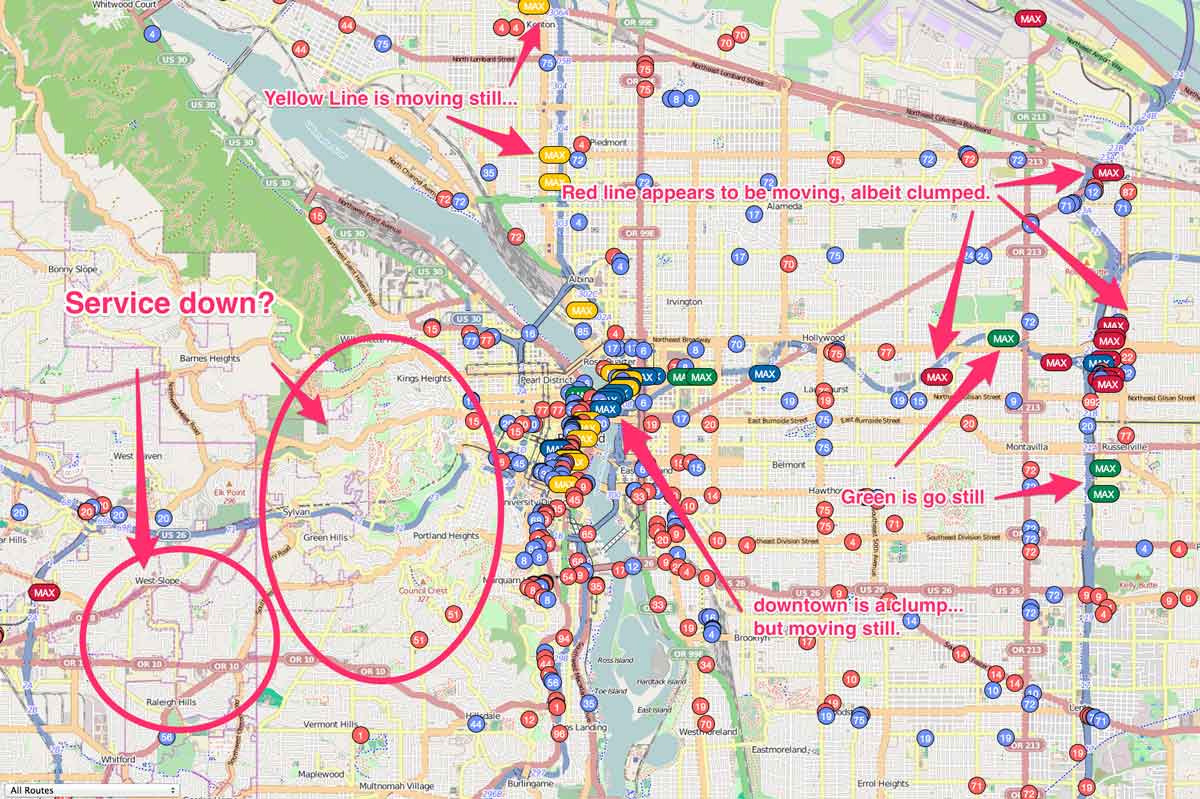
Before moving to far ahead, here’s a snapshot of transit at 4:29pm, still actually running pretty good going into rush hour.

Status as of 4:29pm on Thursday

Status as of 4:29pm on Thursday

‘A 100 Crashes’ of ‘chaos’. It’s called road infrastructure & auto-dependency dumb ass.

Meanwhile, as usual, the suburbs are definitely failing at this whole snow thing.

Well, except for people on bikes or such. It seems this is the running theme.

One of the only times DALLAS (yes, Dallas) is looking a little like Portland.

Portland Milwaukie Light Rail Bus Planning

In the coming months Trimet is going to be putting together a bus plan for the redundant service along the new corridor. The simple reasoning is that buses cost more to operate over time than light rail, a lot more, and the ideal situation is to get as many people to take the light rail and operate feeder service to get people to the light rail. This is a tricky process, here’s a few of the reasons why:

  • Some bus lines would be more logical, like the #33, the stop in Milwaukie or the last stop of the PMLR line and transfer all passengers to a waiting MAX train. The MAX won’t have traffic to battle, will have an easier and faster ingress trip and egress trip out of the city. Timing the connection with the #33 will be really easy, as the service can now operate as an extension of the light rail service instead of fighting with traffic on McLoughlin (the bulk of its trip between Portland and Milwaukie). So a large part of the #33 route could be canceled, saving millions per decade and putting that money into other bus operations and capital such as the #33 between Oregon City and Milwaukie.
  • Other bus lines get tricky, the #19 for instance will cross over (with its current route) the new MAX at one of the stations. But the route on either side of that serves people that may or may not be going downtown. Beyond that, making connections with the MAX is more difficult because of its less than frequent service and which direction would connect with which MAX? The #19 wouldn’t just be merely an extension, but instead would act largely like a feeder. An example would be, if someone got on in the suburbs, instead of riding the whole route it would be faster to deboard and alight the coming MAX train, that would arrive in town faster and more reliably than the #19 bus would. This route then becomes a question of, “what to do?” Increase service? Leave it untouched? Decrease service between X & Y points, increase service immediately between MAX connection points to enable better connector service?
  • #31 and #32 both come from various parts of the metro area and converge on McLoughlin, again making for a perfect direct connection with the MAX. However both buses are arguably faster during low traffic times and slower during higher traffic times. Both bus routes are generally low ridership, so connecting the transfers to the MAX might behoove costs, but maybe not ridership. It however could have the opposite affect on ridership and increase. Would having the end points connected between Clackamas Town Center (where one of the buses goes) vs. where the other goes be improved if we bumped up service levels and connected it reliably to the MAX line going in? What would be the loss vs. the gain of doing so? Whatever the case, it isn’t smart continuing to run these two routes as is when the MAX line offers a lower cost option than running the bus just for the few riders that do take it along the McLoughlin Corridor – in this case, one would logically try the increased connector service but eliminate the service along McLoughlin into downtown. This would create a two-seat (ie. a transfer is required) ride to downtown but it would make for a dramatically more cost efficient ride if the ridership stays relatively the same on these routes or slightly increases. If it increases dramatically it would still be best to transfer riders to the MAX instead, as more service could be provided overall.

Have you thought much about how the service will change, what might change, or thought about getting involved? If any of these buses are ones you ride you should check out the upcoming bus service planning around the opening of the PMLR line. You can’t wait and expect to make a difference, you have to get involved now! Here’s a list of the lines that will be affected with the opening of the PMLR in 2015 (and possibly sooner even).

  • 9-Powell Blvd
  • 17-Holgate/Broadway
  • 19-Woodstock/Glisan
  • 28-Linwood
  • 29-Lake/Webster Rd
  • 30-Estacada
  • 31-King Rd
  • 32-Oatfield
  • 33-McLoughlin
  • 34-River Rd
  • 35-Macadam/Greeley
  • 36-South Shore
  • 43-Taylors Ferry Rd
  • 66-Marquam Hill/Hollywood
  • 70-12th/NE 33rd Ave
  • 75-Cesar Chavez/Lombard
  • 99-McLoughlin Express
  • 152-Milwaukie

Reading Portland Transport, The Roman Candle Bakery Came Up…

There’s an article over at Chris Smith’s blog Portland Transport on “Repeating the Sins of Other Modes“. I left a comment since I’m intimately familiar with the area now. I’ll leave it to you to read the article (even you guys that were jack asses and got banned from commenting can at least read it). Here’s my comment however on Division Street and the immediately few blocks where the Roman Candle Bakery Co. is located at.

“Ah, very cool you stopped by there. It’s a great joint. I live barely a block away and am there regularly. The bike racks are routinely consumed by the employees of Roman Candle and the other businesses that are located in that building (there are more than the two you can see from the street). In addition there is minimal parking for bikes near the car-free apartments also, which has street level businesses. Matter of fact, let’s lay this out real quick.

Roman Candle*, Pok Pok, Whiskey Soda, Caffe Pallino, Kuava House, Detour Cafe, Artigiano, Salt & Straw* and other businesses along this street ALL have significant numbers of employees that bike to work. All stats that the city has zero way to measure – pumping up bike commuter numbers even higher than they appear in trending analysis. The #4 brings nobody to work that I’ve observed to any of these businesses. It does however bring customers. The irony is, there is this big complaint about the supposed lack of auto-parking in the area, which may one day exist. Currently though the only REAL shortage of parking is for cyclists along this route. During the course of the day all the parking, corals, bike racks on sidewalk and more are routinely filled up along with all the signs and posts of sorts along the way.

The cycling traffic in this corridor is only posed to explode even more with the Clinton Street bike corridor connecting directly to the bike highway over the new transit/ped/bike bridge.

Anyway, that might shine some insight on this area. It’s heavily, HEAVILY trafficked by bikes.

A few more tidbits.

One thing I noticed about people – that are obviously not Portlanders – is they tend to come in two different ways to the area to eat, drink and be merry. The Vancouverites who can’t seem to put one foot in front of the other come by car. People from New York, Chicago, San Francisco and other cities almost always come by cab. On Friday and Saturday night Pok Pok has an almost unending stream of Taxis bringing 1, 2, 3 and sometimes 4 or 5 people to Pok Pok. The line doesn’t end until late and the businesses across the street also routinely have taxis dropping people off. This is a great thing considering many, if not all partake in good beverages over there. Usually not to the point of “drunkiness” but it sure beats em’ trying to drive to and fro.

Overall, in the near future it appears that two major things will have to happen at some point.

1. Something is going to need to be done with the automobiles on Clinton that use it as a thruway to 39th. They speed and more than a few end up just blowing through the stop signs and pass dangerously, ESPECIALLY during rush hour when Clinton Street is packed with an unending stream of cyclists going by. I do mean unending too. Often spaced side by side or one after another, sometimes packed together. But from about 4-6pm the road should be primarily cyclists, the motorists pose a dangerous risk and are not following the intended corridor of Division.

2. Transit service is going to need bumped up as well as bicycle amenities along this corridor. If the apartments that are car-free are truly going to attract people without cars (which there is reasonable estimation that a number of people there will actually be car-free) they’ll really need to have some bus service, and right now the #4 is not particularly frequent nor is it reliable. Maybe that’ll change one day but right now… damn it’s frustrating when there is commonly a gap between buses that exceeds 30 minutes when they’re supposed to be *frequent*.”

So go leave a comment over there or leave one here, whatever the case. What would your solutions be to the pending carpocalypse of parkingocalypse in the Division street area? I’m real curious what you think of the pending issues with the Clinton Street bike boulevard corridor. A street which is by all means paid for with general budget funds with not a penny to be seen from the gas tax. Do bikes, the most numerous and efficient users of the street get a little protection or do the corridor runners get precedence still? Sharing is all grand (not really for many) but when you’re routinely threatened because the cars can’t “get around” ya through the small road and they start playing chicken with the oncoming traffic, things are about to get super sketch.